

How to Help Your Child Choose a Career Path: The Bedrock Blueprint for 2026
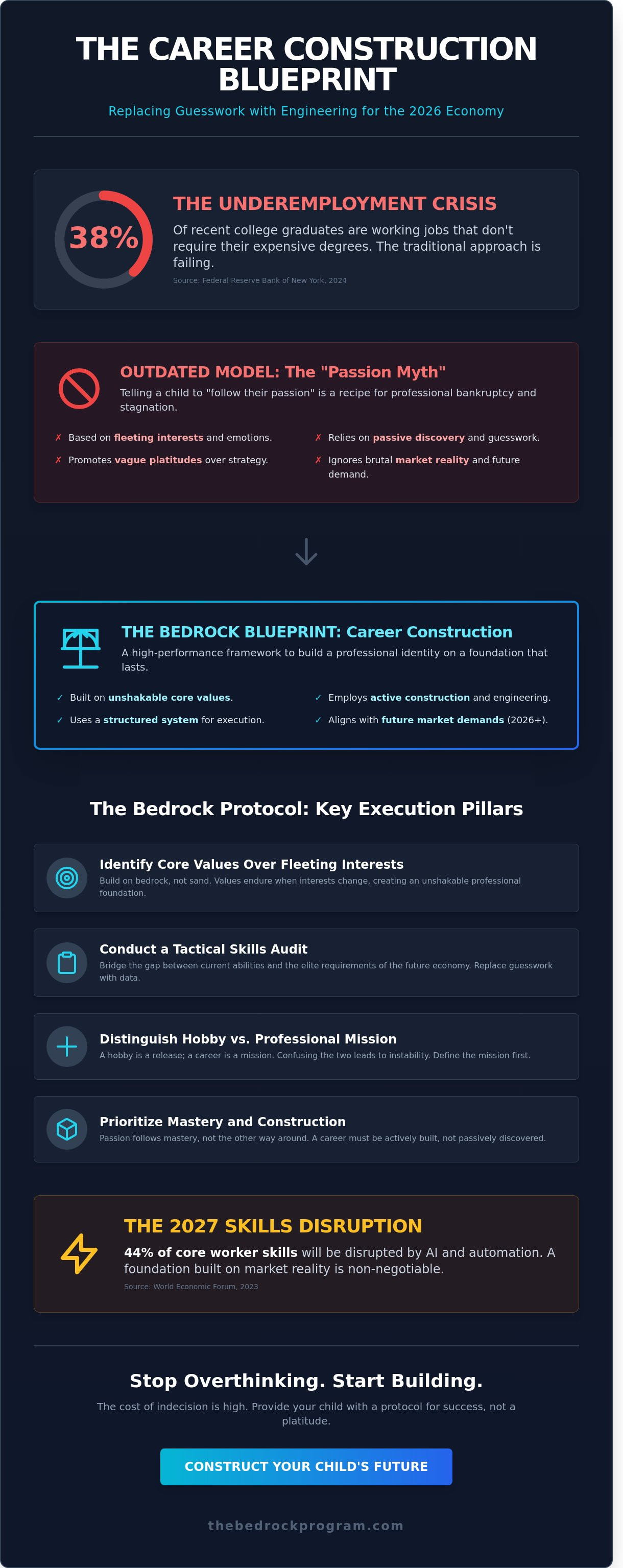
Following your passion is the fastest way to lead your child into professional bankruptcy. In 2024, the Federal Reserve Bank of New York reported that 38% of recent college graduates are underemployed. They are working jobs that do not require the expensive degrees they are still paying for. You are likely wondering how to help my child choose a career path that actually yields a return. The current system is failing. Vague school counseling and "follow your heart" platitudes are not a strategy. They are a liability.
You realize that a career is not a feeling. It is a construction project. You need a structure that holds up when the economy shifts. We are here to replace guesswork with engineering. This guide delivers a high-performance framework to construct a professional identity based on core values and market reality. No more "passion" myths. Just results. No guesswork. Just execution.
We will execute a step-by-step protocol to identify your child's unique value proposition and build an unshakable foundation for their future. This is the Bedrock Blueprint for 2026. It is time to stop overthinking and start building.
Key Takeaways
Ditch the "passion myth" and learn how to build a professional identity based on unshakable core values rather than fleeting interests.
Master the execution blueprint on how to help my child choose a career path by aligning high-performance standards with future market demands.
Identify the critical difference between a hobby and a viable professional foundation to ensure long-term career stability.
Conduct a high-level tactical audit to bridge the gap between current skills and the elite requirements of the 2026 economy.
Replace guesswork with a structured system that prioritizes professional mastery and construction over accidental discovery.
Table of Contents The Crisis of Career Choice: Why Traditional Advice Fails Gen Z The Bedrock Protocol: Identifying Core Values Over Fleeting Interests Interests are Fleeting, Standards are Permanent: Re-evaluating Career Readiness The Execution Blueprint: A 5-Step Tactical Plan for Parents Mastery Over Chance: Securing Your Child's Professional Future
The Crisis of Career Choice: Why Traditional Advice Fails Gen Z
Most parents are operating on an outdated operating system. They offer advice that worked in 1995, but the market has evolved. True career path guidance isn't a list of suggestions. It's a strategic alignment of internal values and external market demand. You aren't just helping them pick a job. You're building a foundation for life. The "Passion Myth" is the first thing you must kill. Telling a child to "do what they love" is a recipe for professional stagnation. Passion follows mastery; it doesn't precede it. If you want to know
how to help my child choose a career path
, stop looking for what's "fun" and start looking for what's viable. Research into
shows that structural alignment beats emotional whims every time. The 2026 landscape is already here. Automation and AI have shifted the requirements for entry-level roles. A 2023 report from the World Economic Forum suggests that 44% of workers' skills will be disrupted by 2027. School counselors aren't equipped for this shift. They focus on academic theory and credit requirements. They don't understand workplace execution or the brutal reality of the modern economy.
The Failure of Passive Parenting in Career Planning
Waiting for your child to "discover" themselves is a losing strategy. Career readiness requires active construction. It's an engineering project, not a scavenger hunt. Passive parents allow their children to drift into the "Modern Mediocrity" trap. This is where a student settles for the path of least resistance because nobody set a higher standard. The cost of indecision is high. Gap years without a specific blueprint lead to a 15% loss of momentum in academic and professional settings. Indecision isn't a phase; it's a lack of leadership. You must provide the protocol for discovery. You don't wait for the foundation to pour itself. You build it.
Bridging the Education-Workplace Gap
Degrees no longer guarantee a professional identity. A diploma is just a piece of paper; it doesn't ensure job security in a volatile market. The gap between what a university teaches and what a high-performance firm requires is widening. This is why
is now an early-stage requirement. Learning
how to help my child choose a career path
means looking beyond the classroom. You need to build a foundation that survives economic volatility. This requires a shift in mindset.
Stop prioritizing "major" over "marketability."
Start demanding measurable skill acquisition.
Execute a plan that values results over theory.
The Bedrock Protocol: Identifying Core Values Over Fleeting Interests
Interests change. Values endure. If you focus on what your child likes today, you're building on sand. You need to build on bedrock. Long-term career satisfaction requires a match between personal standards and industry demands. This is the primary directive in how to help my child choose a career path. Stop chasing "passion" and start identifying non-negotiables. Passion is a feeling. Standards are a commitment.
A hobby is a release; a career is a mission. Don't confuse the two. Data from the US Bureau of Labor Statistics shows the average worker changes jobs 12.4 times between ages 18 and 54. Without a value-based foundation, each shift is a crisis. Use a career exploration program to bridge the gap between simple interests and high-level execution. This provides the data needed to drive clarity. No guesswork. Just results. Evidence-based coaching eliminates the noise and focuses on measurable strengths.
The Values Assessment: A No-Nonsense Audit
Stop asking what they like. Start asking what they stand for. Use these practical exercises to audit their professional standards. Move beyond surface-level statements. "I like art" is useless. "I value creative problem-solving and total autonomy" is a blueprint. Match their interests against the 17 UN Sustainable Development Goals. This anchors their career to global impact rather than temporary whims. It defines their "Why" before they ever choose a "What." This is the core of how to help my child choose a career path with precision.
Standard 1: Autonomy vs. Structure.
Standard 2: Social Impact vs. Individual Mastery.
Standard 3: Stability vs. High-Stakes Risk.
Standard 4: Collaborative Environments vs. Solo Execution.
The Bedrock Framework for Students
We build professional identities through a structured protocol. We don't wait for "inspiration" to strike. Clarity is the ultimate competitive advantage for Gen Z graduates. A 2023 survey revealed that 75% of new hires feel underprepared for the professional environment. This lack of direction is a failure of leadership. Our execution blueprint fixes this by establishing clear performance markers. We force a transition from a student mindset to a high-performance professional mindset. This requires discipline. It requires standards. Most importantly, it requires a definitive architectural map for their future. Every decision must be a calculated step toward mastery. This is the only way to ensure they thrive in a competitive market. Start building the foundation now. Stop settling for mediocrity.
Interests are Fleeting, Standards are Permanent: Re-evaluating Career Readiness
The number one objection parents raise is a fear of pressuring their child. They think silence is a gift. It is actually a weight. Reality proves that a lack of direction is the real source of pressure for a young adult. An aimless student is a stressed student. If you want to know how to help my child choose a career path, you must stop coddling their indecision. You provide the framework; they provide the effort. This is the blueprint for a successful transition into adulthood.
High-performance standards are the antidote to the modern crisis of choice. These standards are not about picking a job title at sixteen. They are about the relentless execution of daily protocols. Discipline beats motivation every single time. Motivation is a feeling that fluctuates with the weather. Discipline is the bedrock. It is the commitment to a process even when the spark is gone. You are not raising a worker; you are developing a professional who understands that results are the only currency that matters.
Accountability is the engine of the student, parent, and coach triad. Each member has a specific role to play in this system. The coach provides the strategy. The parent enforces the environment. The student executes the work. Research on how parents can help suggests that active involvement in career preparation is vital for long-term stability. Stop being a spectator in your child's life. Start being the architect of their foundation. No more guesswork. Just execution.
Rejecting the Wellness Trap in Career Advice
The wellness trap tells kids to "find themselves." This distracts them from the real work: building themselves. Finding yourself implies you are already finished and just hidden. You are not. You are under construction. Supportive coaching is not about enabling mediocrity. It is about establishing a protocol for professional growth that demands measurable results. You must replace vague self-discovery with a strategic blueprint for how to help my child choose a career path based on hard skills and market demand. Eliminate the fluff. Focus on the foundation.
The Mastery Standard
Being "good" is a death sentence in globalized markets like Dubai or London. Competition is fierce and unforgiving. Your child must adopt a High-Performance Architect persona. This means they build their skills with the precision of an engineer. You support self-mastery by holding them to a standard of excellence, not by picking their specific major. Mastery is the only security in an unstable world. When a student masters the art of learning and execution, the specific career path becomes a secondary detail. They will succeed because their standards are unshakable.
The Execution Blueprint: A 5-Step Tactical Plan for Parents
Stop guessing. Stop hoping they figure it out. Career success isn't a lottery; it's an engineering project. If you want to know how to help my child choose a career path, you must stop acting like a cheerleader and start acting like a strategist. You need a protocol that prioritizes results over feelings.
Step 1: The High-Level Audit. Conduct a brutal assessment of their current skills versus 2024 market standards. If their communication grit or technical baseline doesn't meet the top 10% of industry requirements, the plan is already failing.
Step 2: High-Performance Exposure. Get them into rooms where the stakes are real. They don't need a tour; they need to see the pressure of a closing room or a high-stakes engineering sprint.
Step 3: Values-Based Selection. Stop picking majors based on prestige. Use a protocol that aligns university choices with their core drivers and long-term autonomy.
Step 4: Identity Shift. Kill the "student" mindset. They must begin building a professional identity today. This means a portfolio of work, not just a folder of grades.
Step 5: Professional Coaching. You're too close to the problem. Your emotional bias creates friction. Secure an objective mentor to provide the raw data and accountability required for a 100% success rate.
Tactical Exposure: Beyond Internships
Internships are often passive. You need mentors who represent the bedrock of their industry. These are the individuals who set the standards and execute daily. Encourage shadowing that focuses on the grind, the stress, and the execution, not the perks. To bridge the gap between theory and reality, utilize student engagement programs for universities in the UAE to provide a structured environment for this growth. This isn't about padding a resume. It's about testing their metal in a controlled, high-performance setting.
The Parent as the High-Performance Mentor
Change the dinner table conversation immediately. Stop asking "What did you do today?" and start asking "What standard did you meet today?" This is how to help my child choose a career path with actual substance. You must provide the tough love that builds professional grit. Resilience isn't taught in a classroom; it's forged through high expectations and accountability. You're building a blueprint for a life of execution. If they don't feel the weight of their own future now, the market will crush them later. Set the standard. Demand mastery. No excuses.
Ready to build an unshakable foundation for your child's future?
Mastery Over Chance: Securing Your Child's Professional Future
Most parents treat their child's future like a high-stakes lottery. They wait and hope their child "finds" a passion. Hope is a failing strategy. You don't find a career path. You construct it. This is the Bedrock philosophy: Construction over discovery. If you want to know how to help my child choose a career path, stop waiting for inspiration to strike. Inspiration is for amateurs. Mastery is for those who follow a blueprint.
Waiting for a crisis is a financial disaster. Data from the National Center for Education Statistics shows that 30% of undergraduates change their major at least once within three years. This indecision costs families between $15,000 and $30,000 in additional tuition and lost wages. Investing in career coaching before the crisis hits is a high-yield move. It secures the six-figure investment you're already making in their education. We transform students into high-performance assets that employers actually want to hire.
We don't produce graduates; we produce operators. Most students enter the workforce with a degree and zero direction. They're liabilities. The Bedrock Program changes the equation. We build the foundation of discipline and clarity that allows them to hit the ground running. Employers don't hire for potential; they hire for the ability to solve problems. Learning how to help my child choose a career path requires a shift from passive observation to active architectural planning. We provide the tools to make that shift permanent.
The Bedrock Program for Students
Our coaching is a structured protocol designed for results. We don't deal in vague advice. We use clarity workshops to identify core values and strengths. Our evidence-based frameworks deliver measurable professional growth that you can see in real-time. This is about building a standard of excellence. The signature 'Blueprint' for Gen Z career mastery includes:
Values-Based Coaching: Aligning career choices with internal drivers for long-term stability.
Clarity Workshops: Eliminating the noise of modern distractions to focus on high-impact goals.
Execution Protocols: Teaching the habits of elite performers to ensure they don't just start, but finish.
Take Command of the Future
The Bedrock approach is the only definitive map for a student's professional journey. Stop leaving your child's future to chance. Book a clarity session or join our next workshop today to start building an unshakable foundation. Excellence is a standard, not a suggestion.
Execute the Blueprint for Professional Mastery
The old ways are dead. Relying on fleeting interests or outdated school advice is a recipe for failure in the 2026 job market. You now have the tactical framework to move from passive observer to active architect. Focus on core values over temporary hobbies. Use the 5 step execution protocol to replace uncertainty with measurable mastery. This is how to help my child choose a career path without leaving their future to luck.
Success isn't an accident; it's a system. Founded by Audrey Hametner, a former global executive, our methodology aligns with the UN Sustainable Development Goals to ensure global relevance. We utilize evidence-based frameworks specifically engineered for Gen Z retention. No fluff. No guesswork. Just a foundation built for dominance in a shifting professional world.
Don't wait for the crisis to hit. Build the foundation today. Build your child's professional blueprint with The Bedrock Program. You have the tools to secure their legacy. Now lead them toward it.
Frequently Asked Questions
Is it too early to start career planning in middle or high school?
It's never too early to build a solid foundation. When considering how to help my child choose a career path, starting in middle school allows a student to test different protocols before the stakes get high.
Data shows that 27 percent of college grads work in jobs unrelated to their major. Early planning eliminates this waste of time. You're building a framework for elite decision-making and long-term mastery.
How do I help my child if they have absolutely no interests or hobbies?
If interests are missing, focus on execution and discipline. A lack of interest usually stems from a lack of exposure or a fear of failure. Set a standard of trying three new high-skill activities every six months.
This isn't about finding a passion; it's about data collection. You're helping them identify what they don't hate so they can begin to master what they do well. Action creates clarity.
What is the difference between a career counselor and a career coach?
A counselor analyzes where you've been, while a coach builds the blueprint for where you're going. Counselors often focus on academic requirements and entry-level placement. They handle the bureaucracy of education.
A career coach focuses on high-performance execution and long-term mastery. It's the difference between reading a map and driving the car. One provides basic information; the other demands specific results and total accountability.
Can values-based coaching help my child choose a university major?
Values-based coaching is the only way to ensure long-term stability. When you learn how to help my child choose a career path, you must start with their internal standards. This is the bedrock of their future.
If a student values autonomy but chooses a major leading to a rigid corporate hierarchy, they'll burn out by age 25. Aligning a major with core values ensures the investment in tuition pays dividends.
How much should a parent be involved in the career choosing process?
You are the architect providing the blueprint, not the laborer doing the work. Your role is to set the standards and provide the resources for exploration. Research from 2022 indicates that 50 percent of career satisfaction comes from personal autonomy.
Guide the process by asking hard questions and demanding total accountability. Support the execution, but let them own the results of their choices. This builds the strength they'll need later.
What if my child's chosen path doesn't seem financially viable?
Apply a rigorous business protocol to their chosen path immediately. If they want to pursue a low-ROI field, they must develop a secondary high-income skill set to fund it. Don't squash the dream; demand a viable financial blueprint.
According to the Federal Reserve, 40 percent of recent grads are underemployed. They need to understand the market value of their skills before they sign the first tuition check. Mastery requires a solid economic foundation.
How does the Bedrock Program handle Gen Z's specific workplace anxieties?
We replace anxiety with a proven system of execution and discipline. Gen Z faces a 33 percent higher rate of workplace stress compared to previous generations. The Bedrock Program eliminates this by establishing clear standards and repeatable protocols.
We don't coddle feelings; we build competence. When a young man knows his blueprint is solid, the noise of the modern workplace loses its power to distract him. Results are the only antidote to fear.



Comments