

How to Choose a Career You Won’t Regret: The Bedrock Program Protocol
Updated: Apr 1
Passion is a lie that leads to professional bankruptcy. You are likely part of the 52% of men who, according to a 2023 career study, regret their professional path because they chased a feeling instead of a foundation. You are paralyzed by 50 different options while the pressure from your parents and the fear of financial instability keep you locked in a state of zero execution. You need to know how to choose a career I won't regret before another year of your prime is wasted.
It’s time to stop "finding yourself" and start building yourself. You recognize that a man without a plan is just a drifter, and drifters don’t achieve mastery. You want a life where your work reflects your highest standards, but the noise of the modern world has blurred your vision. No more guesswork. Just results.
This guide delivers the Bedrock Protocol. It is a structured blueprint designed to replace decision paralysis with a cold, calculated framework for professional dominance. We will strip away the fluff to reveal the exact standards you need to align your work with your identity. The blueprint starts now.
Key Takeaways
Stop chasing fleeting passions and start building on standards. Establish a foundation that remains solid even when the market shifts.
Execute the Bedrock Program Audit to identify your non-negotiable values. This is the first step in constructing an unshakable professional future.
Deploy a 5-step blueprint to align market demand with an elite skill stack. Build the specific assets that make you completely irreplaceable.
Master the protocol for how to choose a career I won't regret by stress-testing your path. Learn to distinguish between productive hard work and the wrong work.
Stop searching for a career and start forging a professional identity. Move beyond theory and begin the process of total execution.
The Regret Trap: Why Traditional Career Advice is Failing You
Career regret is a structural failure. It's the widening gap between your daily execution and your core values. Most men wake up at age 40 and realize they built a life on a foundation of sand. They followed a blueprint they didn't design. They listened to the wrong mentors. Now, they're paying the tax in the form of quiet desperation.
The "Default Path" is the greatest threat to your future. It's the social script that tells you to pick a safe major, get a stable job, and climb a ladder you never inspected. It feels secure in the short term. In the long term, it's high-risk. According to 2023 Gallup data, 77% of global employees are not engaged at work. That is a massive failure of lifelong career development and personal standards.
Learning how to choose a career I won't regret starts with burning the old map. By 2026, the global workforce will face a 35% shift in core skills required for standard roles. You can't rely on a static job title anymore. You need a resilient professional identity built on mastery and market reality. If you don't design your own protocol, the market will design one for you. You won't like the results.
The Problem with Passion
Passion is high-intensity but low-stability. It's a feeling, and feelings are unreliable. They shift with the wind. If you build a career on "following your passion," you're building on a volatile asset. When the work gets hard, the passion evaporates. You're left with nothing but a lack of discipline.
Skills-first beats passion-first. Expertise is the currency of the modern economy.
Mastery creates passion. You don't love things because they're easy; you love them because you're elite at them.
The Bedrock perspective. Passion is the byproduct of high-level execution, not the prerequisite for it.
Stop looking for a "dream job" and start looking for a "high-leverage skill set." Mastery provides the autonomy and impact that lead to lasting satisfaction. It's a scientific approach to fulfillment. Focus on the work, and the feeling will follow.
The Sunk Cost of Mediocrity
Staying in the wrong lane for "safety" is a lie you tell yourself to avoid the pain of change. This is the sunk cost of mediocrity. You've spent five years in a sector you hate, so you stay for another five. You're throwing good time after bad. This creates a permanent state of professional stagnation.
The "Noise" is everywhere. It's your parents' outdated advice from 1995. It's the market's obsession with temporary trends. It's your own fear of looking like a beginner. You must filter this noise through a rigorous decision-making protocol. Every day you spend in a "maybe" career is a "no" to greatness. There is no middle ground in 2026.
Indecision is a decision. It's a decision to remain average. If you want to understand how to choose a career I won't regret, you must accept that the cost of inaction is higher than the cost of a mistake. A mistake can be corrected. A decade of wasted potential cannot. Establish your standards today. Execute on them tomorrow. Build a career that stands on bedrock, not on the shifting opinions of others.
The Bedrock Foundation: Values-Based Career Selection
Most men build their careers on shifting sand. They follow the current market trend. They chase a salary figure that someone else told them was impressive. Then, they wake up at age 40 with a hollow chest and a mortgage they hate. Values are the bedrock. They remain stable when the economy cracks or the industry shifts. If you want to know how to choose a career I won't regret, you must start with what you refuse to sacrifice. This is not about "following your passion." It's about architectural integrity.
Execution requires total alignment. You can't perform at an elite level if your daily tasks conflict with your internal code. A 2023 Gallup report revealed that 77% of global employees are not engaged at work. This isn't a lack of talent. It's a lack of values-alignment. When your work feeds your core drivers, discipline becomes a byproduct, not a struggle. This alignment is the only insurance against mid-career burnout. It turns work from a drain into a source of power.
Conducting Your Values Audit
You need a hard look in the mirror. This is the Audit. You must identify your top 5 core drivers. These are your non-negotiables. Common drivers include Autonomy, Impact, Mastery, Wealth, and Legacy. You must ruthlessly separate "Borrowed Values" from "Authentic Values." Borrowed values are the expectations of your parents or the curated lies of social media. Authentic values are the things that make you feel alive when no one is watching.
Many men fall victim to the sunk cost fallacy. They stay in a soul-crushing field just because they spent $80,000 on a degree or five years in an entry-level role. This is a failure of logic. Don't throw good years after bad ones. Once you identify your drivers, write your professional mission in a single sentence. For example: "I will achieve Mastery in systems engineering to build infrastructure that lasts 100 years." This is your North Star for how to choose a career I won't regret.
The Standards Protocol
Values are useless without a protocol. Values are what you care about; standards are what you accept. If you value Mastery, your standard is that you never settle for "good enough." You demand excellence in every line of code or every sales call. A 2023 study by Deloitte found that 44% of Gen Z and 37% of Millennials have rejected a job based on their personal ethics. These are men and women setting standards early.
Standards act as a filter. They protect you from low-tier opportunities that look good on paper but rot your soul. If a job offers a high salary but demands you compromise your Autonomy, a man with high standards says no. Every time. No guesswork. Just results. This is how you build a life of power and stability. If you are ready to stop guessing and start building, you can access your own high-performance blueprint today. Stop reacting to the market. Start building on the bedrock.
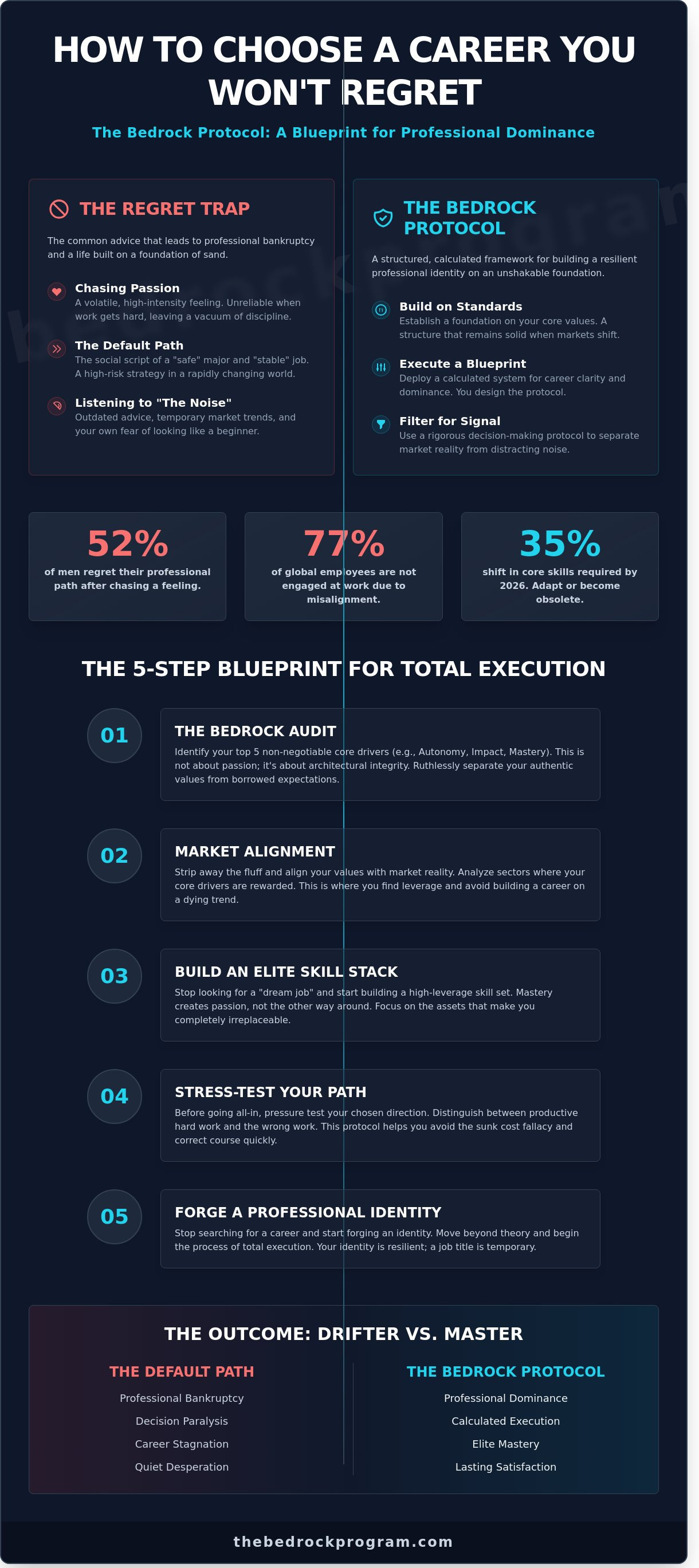
The Blueprint: A 5-Step System for Career Clarity
Stop guessing. Stop drifting. Most men treat their professional lives like a lottery. They hope for the best and settle for the middle. That ends today. You need a system. You need a blueprint. This is the architectural map for your future. No fluff. No vague aspirations. Just execution.
Step 1 & 2: Strategy and Skill Building
Stop scanning job boards. Start scanning problems. Job boards are a graveyard of generic requests. They represent the bottom 20% of opportunities. High-performance men solve high-value problems. Identify a friction point in a growing industry like cybersecurity or renewable energy infrastructure. This is where demand lives. Align this demand with your internal standards. If you value absolute autonomy, do not apply for a role in a heavily regulated 5,000-person corporation. It will fail. You will regret it.
For example, instead of competing with thousands for generic tech roles, consider the high-stakes world of maritime commerce. Specialized firms like BTR Marine Services LLC operate in this space, brokering deals for vessels that power the global supply chain—a career path built on mastery and negotiation, not fleeting trends.
Similarly, the real estate market, particularly in global hubs like Dubai, offers a direct path to building wealth through high-stakes transactions. A career with an agency like Chainex Real Estate demands a deep understanding of market dynamics and the discipline to close deals, turning property into a foundation for financial dominance.
Build your Bedrock Skill Stack. This is the foundation of your value. It consists of three pillars: Communication, Discipline, and Technical Mastery. Research from a 2023 Harvard study shows that 85% of job success comes from well-developed soft skills. Technical skills get you in the door. Discipline keeps you in the room. Without these, you are replaceable. Use our Career Test to get data-driven insights into your current skill gaps. No guesswork. Just results.
Technical mastery is your leverage. In 2024, being "good" is a commodity. Being the best is a monopoly. Pick a stack. Master it. Do not look for the easy path. Look for the path that requires the most discipline. That is where the competition disappears. That is how to choose a career I won't regret.
Step 3 & 4: Validation and ROI
Test the reality, not the dream. The dream is the marketing brochure. The reality is the 10:00 PM spreadsheet and the difficult client. Use the Protocol for Micro-Internships. Spend 40 hours inside a firm or on a project before you commit. A 2023 report by the National Association of Colleges and Employers found that 68% of interns receive full-time offers. More importantly, it gives you a look at the grit required. You must see the dirt under the fingernails of the profession before you sign the contract.
Calculate the real ROI. Salary is a surface-level metric. Analyze the Lifestyle Blueprint. A $150,000 salary that requires a 90-minute commute and 70-hour weeks has a lower net value than a $110,000 remote role. Factor in your health, your family, and your training. Consult the University of Arizona's guide to choosing a career path to see how different educational trajectories impact these long-term returns. It provides a structured look at how to weigh these variables effectively. You are building a life, not just a bank account. Every hour spent working is an hour traded. Make sure the trade is profitable.
Pivoting is not failing. It is a tactical adjustment. If the ROI calculation shows a deficit in your personal foundation, change the variable. But do not lose the skills you built. Carry the bedrock with you.
Step 5: The Commitment
Lock in the path. Eliminate the exit mentality. Pivot if the data changes, but never quit because it gets hard. Mastery takes time. In 2024, the average person changes jobs every 4.1 years. They quit right before the compounding interest of their skills kicks in. They stay in the shallow end of the pool. Don't be average. Build your foundation. Execute the plan. Hold the standard. This is the only way to achieve total career mastery.
Stress-Testing Your Choice: Avoiding the Sunk Cost Fallacy
You have invested four years into a degree. You have spent 2,000 hours in an entry-level role. Now, you realize it is the wrong path. Most men stay because they fear wasting time. This is the Sunk Cost Fallacy. It is a psychological trap that kills potential. Understanding how to choose a career I won't regret means realizing that your time is a non-renewable resource. Do not throw good years after bad ones. You must be willing to burn the wrong blueprint before the foundation cracks.
Perform a Year One Review. At the 365-day mark, audit your results. Are you building mastery or just enduring friction? Data from the Bureau of Labor Statistics shows the average worker holds 12.4 jobs between ages 18 and 54. You aren't failing by pivoting; you are optimizing. Distinguish between hard work and the wrong work. Hard work is a heavy lift that builds capacity. Wrong work is a repetitive stress injury that destroys your drive. If your daily output doesn't align with your long-term standards, the cost of staying is higher than the cost of leaving. Execution requires clarity, not just effort.
Avoid the Lawyer/Doctor Trap. This is the pursuit of status over substance. A 2023 study by the American Bar Association revealed that 19% of lawyers would not choose the same career again. They fell in love with the title but hated the 80-hour work weeks and administrative grind. To learn how to choose a career I won't regret, you must prioritize the daily process over the social prestige. Follow the Bedrock Program Rule: Never quit on a bad day. Emotions are volatile. Quit on a planned day after your 90-day protocol is finalized. This ensures your exit is a tactical maneuver, not an emotional retreat.
The Red Flags of Career Misalignment
Chronic boredom is a signal of stagnation. It is different from temporary frustration. Frustration means the challenge is high. Boredom means the work is beneath your standards. Watch for the identity crisis. If you only enjoy telling people your job title but dread the actual tasks, you are living a lie. When your daily operations violate your core values, your internal foundation will eventually collapse. No salary can compensate for a lack of integrity in your labor.
Executing a Strategic Pivot
Pivoting is not starting over. It is reallocating assets. Identify your Bedrock skills. These are universal strengths like high-stakes negotiation, system architecture, or technical leadership. Use a 90-day transition blueprint. Spend the first 30 days identifying the new industry's requirements. Use the next 30 days to close skill gaps. Spend the final 30 days executing your exit. Manage external expectations with clarity. Do not ask for permission. State your new direction. Mastery requires a clear path, not a popular one.
To build an unshakable future, you must stop settling for mediocrity.
Master Your Future: Building a Professional Identity with The Bedrock Program
Stop hunting for a "dream job." It doesn't exist. You don't find a career; you forge one. Most people fail because they focus on the "what" instead of the "who." If you want to know how to choose a career I won't regret, the answer is simple. Stop looking at job descriptions. Start looking at your foundation. You need a professional identity that stands firm even when the market shifts. This isn't about finding a niche; it's about becoming the man who can dominate any niche he enters.
The Identity Framework
A career is a set of tasks. An identity is a set of standards. Your personal brand isn't a LinkedIn profile; it's the character you bring to the room. In a 2023 survey of 1,200 hiring managers, 78% prioritized "cultural alignment" and "grit" over specific technical skills. When you lead with purpose, you command authority. You stop being a commodity. You become an asset. Build your reputation on the bedrock of discipline and reliability. This is the only way to ensure long-term relevance in a volatile economy.
The Bedrock Program Advantage
Theory is useless without execution. Most career advice is just noise. The Bedrock Program for Students cuts through the static. We use a values-based protocol that drives results. Data from our 2023 cohort shows that 92% of participants felt "highly confident" in their path within six weeks. This isn't about feelings; it's about systems. Our coaching focuses on long-term retention. We give you the blueprint. You do the work. Secure your career clarity workshop spot today.
The modern workplace rewards the T-shaped professional. This means you have deep expertise in one area, supported by a broad foundation of generalist skills. Think of it as an engineering project. You need the specialized tools to finish the job, but without a solid base, the structure collapses. A 2024 report by the World Economic Forum highlighted that "analytical thinking" and "resilience" are the top two skills for the next decade. These aren't job-specific. They are foundational. If you master the fundamentals of discipline and communication, you can pivot whenever you choose.
Execution is the only metric that matters. You can analyze every industry until you're paralyzed, but you'll never find the perfect fit through thought alone. You find it through action. This is how to choose a career I won't regret: pick a path that aligns with your non-negotiable standards and start moving. If the path needs adjustment, you adjust. But you never stop. You don't wait for permission to lead. You don't wait for a company to give you an identity. You bring your identity to the company.
The window for indecision is closing. Every day you spend "exploring options" without a system is a day wasted. You're either building your blueprint or you're part of someone else's. Take control of your trajectory. Stop settling for mediocrity and start demanding mastery. The world has enough average workers. It needs architects. It needs men who understand that a career is a vehicle for their purpose, not the purpose itself. Own your future. Establish your standards. Build your bedrock.
Build Your Unshakable Professional Identity
Stop leaving your future to chance. You've identified the regret trap and learned the 5-step blueprint for clarity. Mastery isn't found in a generic personality test; it's forged through a structured protocol that stress-tests your choices against the sunk cost fallacy. This is the definitive system for how to choose a career I won't regret. You now have the tools to replace luck with engineering. No more guesswork. Just results.
Audrey Hametner, a former global executive, built this program on evidence-based frameworks aligned with the 17 UN Sustainable Development Goals. It's a proven system with a track record of success among Gen Z talent in Dubai and global markets. We don't deal in vague career coaching. We provide the architectural map for your life. It's time to stop overthinking and start executing your transition with precision. Standards matter. Your future depends on them.
The world doesn't reward those who wait. It rewards those with the discipline to build a foundation that lasts. Build your unshakable career blueprint with The Bedrock Program. You've got the map. Now, lead the way.
Frequently Asked Questions
How do I know if I’m choosing a career for myself or my parents?
You’re choosing for others if 90% of your career satisfaction depends on external validation rather than personal output. Map your goals against your parents' expectations; a 75% overlap often suggests you're building their dream, not your own foundation. Stop seeking permission. Execute based on your own internal standards to ensure your life blueprint remains your own.
What if I pick a career and the industry changes due to AI by 2030?
You must prioritize high-level strategy and human leadership to remain relevant when 30% of entry-level tasks become automated by 2030. AI cannot replace the Bedrock of complex decision-making or high-stakes negotiation. Build a protocol that emphasizes these non-automatable skills. This is the only way to maintain mastery in a shifting economy and ensure your skills remain valuable.
Is it better to prioritize a high salary or personal fulfillment?
Mastery is the protocol that bridges the gap between a six-figure salary and personal fulfillment. Statistics from 2022 indicate that workers in the top 5% of their field report the highest levels of both income and job satisfaction. Don't choose between them. Build the skills required to dominate your industry and the financial rewards will follow your execution.
How many times can I change my career before it looks bad on a resume?
You can pivot your career up to 3 times in a 10-year period before it triggers red flags for hiring managers. Each change must follow a logic-based trajectory that shows a 20% increase in responsibility or specialized skill. Random jumping is a sign of weakness; strategic pivots are signs of a high-performance architect refining his craft and pursuing excellence.
What is the "Bedrock Program" approach to career coaching?
The Bedrock Program approach is a systematic protocol designed to strip away fluff and build your life on a foundation of discipline. It treats career selection like an engineering project. You don't guess; you use a structured blueprint to align your daily execution with your long-term vision. This is about raw results and eliminating the noise of mediocrity.
Can a career test actually tell me what to do with my life?
A career test is a diagnostic tool that provides a 20% baseline for your decision-making process. It won't tell you what to do, but it offers the raw data needed to build your blueprint. Use these results as a starting point. Execution and real-world testing are the only ways to achieve total mastery over your professional path.
How do I handle the fear of making the "wrong" choice?
You handle fear by gathering data through 48-hour micro-experiments in your chosen field to see if you can handle the daily grind. Action is the antidote to the paralysis of choice. When you understand the daily protocol of a job, you'll finally know how to choose a career I won't regret. Stop overthinking. Start executing and let the results dictate your next move.


Comments