

Jobscan: Why Keyword Optimization is Not a Career Strategy
Updated: Apr 14
You're treating your career like a search engine optimization project rather than a high-performance operation. It's a tactical error. You've likely spent 45 minutes tweaking a single resume on jobscan just to see a green checkmark, only to receive another automated rejection 48 hours later. It's a soul-crushing cycle. You feel like a nameless number in a database. You're waiting for a machine to give you permission to succeed. That's not leadership; it's a lack of standards.
I'm here to change the protocol. You'll learn how to stop chasing fleeting algorithms and start building an unshakeable professional foundation that no bot can ignore. We're moving beyond the 80% match rate. This is about execution. I'll show you the blueprint to stand out to human recruiters at high-tier firms so you can stop feeling anxious about the bots. This guide breaks down why your obsession with keywords is stalling your progress and how to reclaim your status as a high-performance architect of your own future. No more guesswork. Just results.
Key Takeaways
Stop chasing algorithms. A high score is useless if your professional foundation is built on sand.
Use jobscan as a tactical sanity check for terminology, not a crutch for your identity.
Build your professional bedrock first. Prioritize high-performance results that command authority over simple keyword matching.
Eliminate keyword stuffing. Recruiters demand standards and proven execution, not a list of buzzwords designed to trigger a bot.
Shift from tactical fixes to a strategic blueprint. Build an unshakeable career foundation that no algorithm can ignore.
What is Jobscan? The Mechanics of the ATS Optimizer
Jobscan is a SaaS tool. It is a tactical aid designed to bridge the gap between your resume and a recruiter's screen. It functions as a comparison engine. You provide the resume. You provide the job description. The software analyzes the data. It identifies the delta between your experience and the employer's requirements. This is not a career strategy. It is a protocol for bypassing digital gatekeepers.
The primary users are job seekers fighting the application black hole. Most are students or mid-career professionals who feel invisible. They send applications into the void. They get nothing back. The jobscan tool offers a way to fight back. It provides a blueprint for keyword optimization. It ensures your document meets the technical standards required to reach a human eye. No guesswork. Just execution.
How the Scan Works
The core mechanism focuses on keyword frequency and hard skills. If a job description mentions "Python" five times, the engine expects to see it in your resume. It matches job titles exactly. It looks for specific certifications. The software also runs formatting checks. It identifies elements that are incompatible with modern parsers. Tables, graphics, and non-standard headers can break the system. These elements make you invisible. The final output is a Match Rate score. This metric measures linguistic alignment. It does not measure your leadership. It does not measure your potential. It measures how well you follow the employer's digital instructions.
The Rise of the ATS
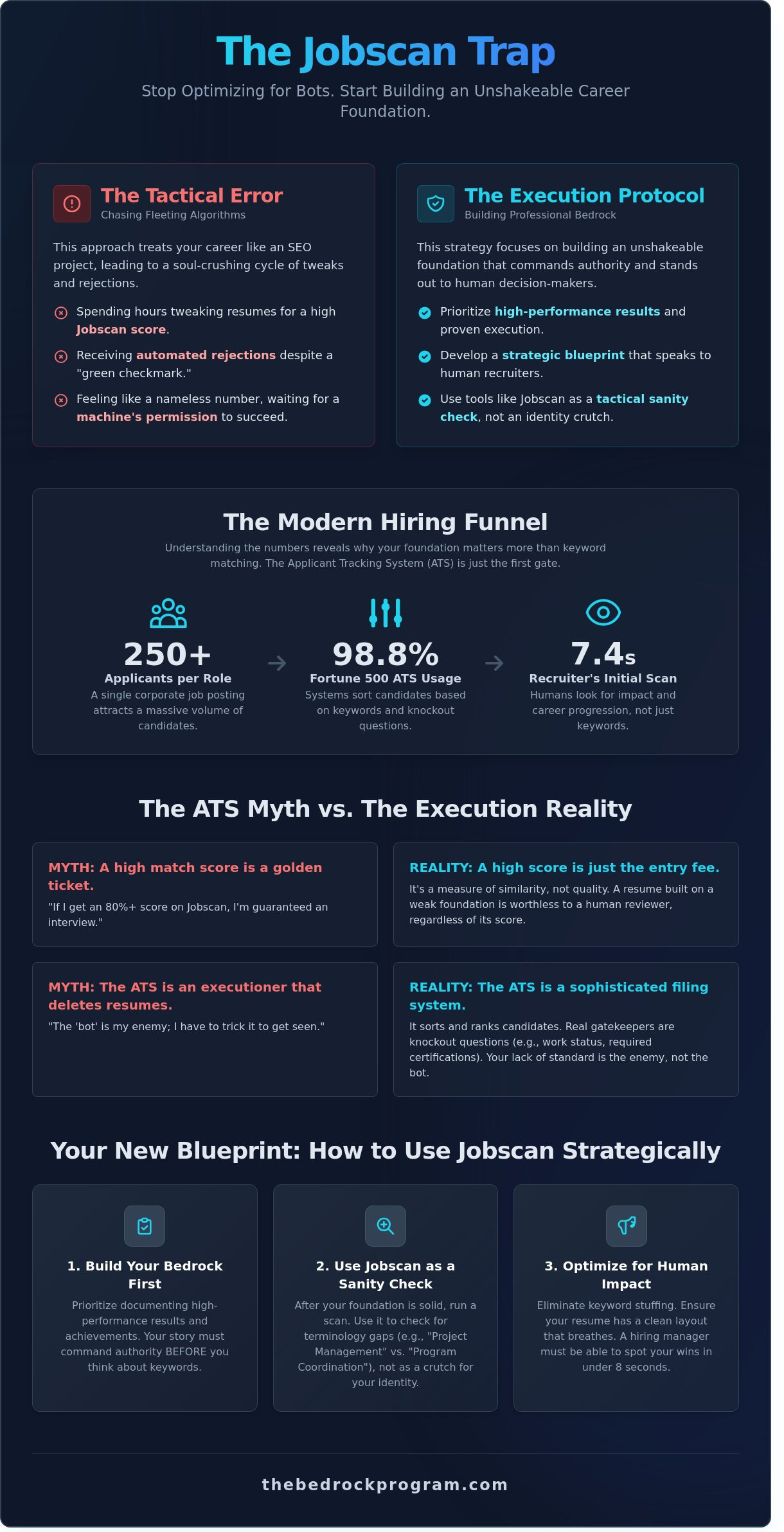
Companies no longer read every resume. They cannot. A single job posting at a major firm can attract over 250 applicants within 48 hours. To manage this volume, 98.8% of Fortune 500 companies utilize an Applicant Tracking System (ATS) to filter candidates. The first round of hiring is now a digital filter. Humans only see what the machine approves. This is the new standard of the corporate world.
This shift has a massive psychological impact. Gen Z candidates often feel like ghosts in the machine. They possess the skills but lack the keyword mastery to trigger the system. They spend hours on applications that are never read. This creates a sense of futility. Jobscan acts as a temporary fix for this systemic issue. It allows you to build a foundation of visibility. It gets you through the door. Once you are in the room, the tool's job is over. Mastery begins where the scan ends.
The Great ATS Myth: Why 'Beating the Bot' is a Losing Game
Stop chasing ghosts. The "bot" isn't your enemy. Your lack of standard is. Most job seekers treat a high jobscan score as a finish line. They think an 80% match score is a golden ticket to an interview. It isn't. It's a metric of similarity, not a metric of quality. Computers don't hire people. Humans do. If your resume lacks a foundation of real achievement, the bot's approval is worthless. You're optimizing for a machine that doesn't sign your paycheck. This is a distraction from the real work of career mastery. Using jobscan to match keywords is a basic protocol. It's not a strategy for elite performance.
Sorting vs. Filtering
The ATS is a sophisticated filing system. It isn't an executioner. It sorts candidates based on specific criteria. It rarely deletes your data without cause. The real gatekeepers are knockout questions. These are the "Yes/No" filters regarding legal work status or specific certifications. If you fail those, keywords won't save you. Being "Rank #1" with a resume that reads like a technical manual is a tactical error. It's better to be "Rank #10" with a narrative that proves mastery. You must build a document that satisfies MIT on ATS-friendly resumes while still speaking to human ambition. A high rank gets you on the list. A high-performance story gets you the interview. Don't confuse visibility with viability.
The Recruiter's 6-Second Scan
Pass the bot. Now what? You face the human element. A 2018 study by eye-tracking experts confirms recruiters spend roughly 7.4 seconds on their initial review. They aren't looking for keyword density. They're looking for career progression and impact. Keyword-stuffed sentences look like fluff to a trained eye. They break the rhythm of your professional story. Professional standards require a layout that breathes. If a hiring manager can't find your wins in 6 seconds, you've lost the game. You're competing against candidates who have a clear blueprint for their professional execution. They don't hide behind algorithms. They lead with results.
Execution matters more than optimization. If you spend three hours tweaking words to hit a specific score, you're missing the point. You're playing a low-stakes game. The goal isn't to be "compatible" with a database. The goal is to be undeniable to a decision-maker. This requires a shift in mindset. Stop acting like a data entry clerk. Start acting like a high-performance architect of your own career. Build your foundation on hard skills and measurable wins. The bot will follow your lead. Results are the only language that matters.
3 Common Misconceptions About Resume Optimization Tools
Optimization tools are not a magic pill. They are a diagnostic. Most men treat these platforms like a cheat code to bypass the work of building a career. They fall into the "More is Better" fallacy. They believe a 95% match rate on jobscan automatically secures a seat at the table. It doesn't. Over-stuffing keywords triggers human spam filters the moment your document hits a recruiter's desk. It kills the rhythm of your professional story. You are a high-performance asset, not a list of nouns. Mentioning a skill is not the same as demonstrating mastery. Mastery requires evidence of execution.
The Keyword Stuffing Trap
Repetitive phrasing destroys the flow of your narrative. When you force keywords into every bullet point, you sound like a bot. Recruiters spend an average of 6.2 seconds on an initial resume screen. If they see a wall of repetitive jargon, they hit delete. There is a massive difference between listing "Project Management" and proving you led a team of 15 to deliver a $2.4 million infrastructure project on time. A Hollow Resume is a document that ranks high in automated systems but reads poorly to the human eye. It lacks the weight of authority. It feels desperate. High-performance professionals don't beg for attention; they command it through clear, concise results.
The Lack of Context
A tool like jobscan cannot measure the scale of your achievements. It sees the word "leadership," but it doesn't understand the pressure of a high-stakes turnaround. It can't quantify the grit required to hit targets in a failing market. This is one of the primary risks of AI in job applications cited by industry experts in July 2025. The machine strips away the man. You need data-backed results. Numbers provide the blueprint of your success. Without them, you are just another applicant matching words. Your professional development and your ability to solve complex problems matter more than your word choice. Standards matter more than synonyms.
This is precisely why high-performance companies are evolving their protocols. They recognize the limitations of pure automation and are adopting platforms like Benchmarcx to measure and benchmark their talent experience in real-time. This ensures the human element isn't lost and that they're building a recruitment process with standards as high as the candidates they seek.
The "One-Click" trap is a shortcut to mediocrity. AI-generated bullet points often lack the raw energy of real-world execution. They feel generic because they are. Similarly, a clean layout is just a shell. A "Formatting Fix-All" cannot save a resume that lacks a values-based foundation. If your career lacks a core protocol, no amount of white space will hide it. Finally, beware the "Identity Crisis." Tailoring your resume too aggressively to fit every job description leads you into roles that don't align with your long-term goals. You end up wearing a mask in an office where you don't belong. Stick to your standards. Build your career on your personal bedrock, not on the shifting sands of an algorithm.
The Execution Protocol: How to Use Jobscan Without Losing Your Identity
Stop chasing percentages. Start building a foundation. Most men treat keyword tools like a cheat code to bypass hard work. They're wrong. Use jobscan as a diagnostic sensor, not a master architect. Your resume must reflect a high-performance reality before you ever touch a piece of software.
Step 1: Build the Bedrock Resume. Document your wins first. Use raw data. If you managed a $4.2 million budget or slashed operational waste by 18 percent, lead with that. This is your professional blueprint.
Step 2: The Sanity Check. Upload your draft. Use the tool to see if your terminology aligns with current industry standards. Don't change your story; just refine the frequency of the terms.
Step 3: Technical Readability. Complex layouts are a liability. Use standard headers and clean fonts like Arial. Your design should never distract from your results.
Step 4: The Leadership Audit. Read the final draft out loud. Does it sound like a man of action or a collection of buzzwords? If the human element is gone, you've failed the protocol.
Step 5: Bypass the Bot. Statistics show that 85 percent of high-level positions are secured through direct networking. Use the optimized resume to clear the gate, but spend 70 percent of your energy on direct outreach.
Setting Your Standards
Identify your core competencies with surgical precision. The No-Fluff rule is absolute. If you didn't execute the task, don't list the keyword. A high match score is worthless if you can't defend it during a high-pressure interview. Maintain your unique voice. You are an architect of results, not a victim of an algorithm. Standards dictate your career trajectory, not software suggestions.
The Tactical Scan
Use jobscan to uncover hidden requirements buried in the job description. Sometimes a listing mentions a specific certification, like a PMP or a Lean Six Sigma Green Belt, that you possess but neglected to mention. That's a tactical win. Follow the 70% Rule. Once your resume hits a 70 percent match, stop. Chasing a perfect 100 percent score leads to keyword stuffing. It erodes your authority. Focus on the mission, not the score. Execution is the only metric that matters.
Establish your professional foundation today at The Bedrock Program.
Beyond the Scan: Building Your Professional Bedrock
Optimization is a tactic. Strategy is a lifestyle. You've spent hours tweaking your resume on jobscan to bypass a bot. That's fine for getting a foot in the door. It's useless for staying in the room. Real career mastery requires a shift from survival to execution. You need a blueprint that defines who you are, not just what you can do. This is the Bedrock Program philosophy. It demands clarity, confidence, and a relentless focus on the person behind the paper.
We don't believe in surface-level fixes. Our work with student engagement programs for universities in the UAE proves this. We focus on building the person, not the document. If the foundation is weak, the structure will collapse. No guesswork. Just results. Stop scanning for keywords. Start building your future.
Values-Based Career Mastery
Knowing your "why" is more powerful than knowing an ATS algorithm. Algorithms change. Values are permanent. When your work aligns with your internal standards, high performance becomes a reflex. You stop being a job hunter. You become a career architect. Architects don't beg for space; they design it. This alignment drives long-term retention. Data shows that 70% of employees stay longer at companies where their values match the mission. Don't chase a paycheck. Build a legacy.
Clarity: Identify the non-negotiables of your professional life.
Confidence: Own your results without apologizing for your ambition.
Execution: Move from planning to doing. Every single day.
Taking Command of Your Future
The modern workplace is a battlefield. You don't walk into a fight without a coach; many professionals turn to experts like Victoria OHare for this guidance. Mentorship provides the protocol for navigating corporate politics and market volatility. It turns years of trial and error into months of progress. High standards are your only protection in a competitive market. If your standards are higher than your boss's expectations, you're untouchable. Mastery is the goal. Discipline is the path.
The jobscan score might get you an interview, but it won't get you the win. The bot doesn't hire you. A human does. Speak to the human. Show them a man who has mastered his craft and his character. Stop hiding behind a screen. Stand on your foundation. Execute the plan.
Execute the Blueprint for Professional Mastery
Stop playing defense against an algorithm. A high match rate on jobscan is a tactical win, but it isn't a career strategy. You've learned that "beating the bot" is a myth that keeps professionals trapped in a cycle of mediocrity. True career longevity requires more than keyword density; it demands a rigorous execution protocol and an unshakeable identity.
Elite performance isn't found in a software hack. It's built through standards. Global executive Audrey Hametner developed a framework backed by the 17 UN Sustainable Development Goals to move beyond empty platitudes. This isn't about guessing what a recruiter wants to see. It's about engineering a professional presence that commands respect in any room, regardless of the technology used to screen you.
Luck is for the unprepared. Systems are for the masters. It's time to stop tweaking margins and start building a legacy that survives the scan. You've got the tools; now apply the discipline. Your future self is waiting for you to take command.
Build your unshakeable professional foundation with The Bedrock Program.
Frequently Asked Questions
Is Jobscan worth the premium subscription for students?
No. Most students don't need the $89.95 quarterly premium plan for Jobscan. The free version provides 5 monthly scans. That's your baseline. Focus on building a bedrock foundation of skills first. Don't waste capital on tools before you have a product worth selling. High-performance careers start with skills, not subscriptions. Execution matters more than premium features. Stick to the free tier until you're chasing six-figure roles.
Can Jobscan help me if I'm changing career paths?
Yes, but only as a secondary protocol. This tool identifies the 20% skill gap between your current resume and your target role. It won't build the bridge for you. Use it to find the high-impact keywords you're missing. Then go get the certifications. A 0% match rate is a signal to rebuild your blueprint. Don't expect software to fix a lack of experience. Mastery requires real work.
How do I know if a company is using an ATS?
Assume they are. 99% of Fortune 500 companies use an ATS like Workday or Taleo. Check the application URL. If you see "myworkdayjobs.com," you're in the system. Don't guess. Follow the standards. Treat every application like a technical operation. If the company has more than 50 employees, they're likely using a tracking protocol. Stay sharp and optimize every single time.
What is a 'good' match rate on Jobscan?
Aim for an 80% match rate on Jobscan. Reaching 100% usually requires keyword stuffing that ruins your human appeal. 80% is the professional standard for passing the initial filter. It proves you've done the work without compromising your integrity. High-performance resumes balance machine logic with human mastery. Don't over-engineer the process. Get to 80%, then stop. Your goal is the interview, not a perfect score.
Will an ATS reject my resume if I use a PDF format?
No. Modern systems like Greenhouse or Lever parse PDFs with 99% accuracy. The PDF preserves your formatting blueprint. It ensures the recruiter sees exactly what you built. Only use .docx if the portal specifically demands it. Stay disciplined with your file types. A clean PDF is the standard for professional execution. Don't let outdated advice weaken your presentation. Build it right the first time.
How do I optimize my LinkedIn profile using these tools?
Use the LinkedIn Optimization feature to scan your profile against 3 target job descriptions. Focus on the headline and skills section. These areas carry 70% of the weight in recruiter searches. It's about visibility. If you aren't visible, you don't exist in the market. Establish your digital bedrock. This protocol ensures your profile works for you while you're focused on execution elsewhere. Results require a professional standard.
Can Jobscan detect AI-written resumes?
No. The system analyzes keyword density and formatting, not the origin of the prose. However, 75% of recruiters can spot generic AI text immediately. Don't let a machine write your story. Use AI for the foundation, but apply your own mastery to the final execution. Standards matter. If your resume sounds like a robot, you've already lost the battle. Use tools to support your work, not replace it.
What are the best alternatives to Jobscan in 2026?
Teal and Rezi are the primary competitors in 2026. Teal offers a comprehensive career growth tracker. Rezi uses AI to build the entire blueprint from scratch. Choose the tool that fits your protocol. Don't get distracted by shiny features. Pick one and execute. Success comes from the man using the tool, not the tool itself. Maintain your standards and keep pushing forward until you reach the objective.


Comments