

How to Become a College Advisor: The Blueprint for High-Impact Career Guidance
Most advisors spend 40 hours a week shuffling paperwork while their students drift without a compass. This is a failure of leadership. If you want to join the elite 14% of academic professionals who drive measurable student transformation, you need a new foundation. Learning how to become a college advisor isn't about filling a seat; it's about executing a high-performance system. Stop guessing which degree you need. Start building your career on bedrock. No fluff. Just results.
You're likely frustrated by the lack of a clear entry strategy for top-tier institutions. You don't want to be another "transactional" employee lost in the bureaucracy. You want mastery. This is your blueprint to dominate the field. You'll gain the exact educational checklist, the essential protocols, and the strategic mindset required to build a legacy in higher education. We're breaking down the three-stage execution plan and the five core standards that separate high-performance mentors from the pack. It's time to stop overthinking and start executing your professional transformation.
Key Takeaways
Stop being a paper-pusher. Learn to transition from transactional scheduling to a high-performance career architect model that drives student results.
Master the educational blueprint. Identify the exact degrees and credentials required for how to become a college advisor who commands respect in the field.
Implement the advisor protocol. Use data-driven empathy and mastery of influence to guide students toward self-mastery and decisive action.
Build your bedrock resume. Focus on high-impact execution and strategic internships to land elite roles and rise through the ranks of student affairs.
Scale your impact beyond the institution. Discover the path to transitioning from university staff to a global career consultant or high-level independent coach.
Defining the Mission: What a College Advisor Does in 2026
The era of the paper-pusher is dead. In 2026, a college advisor doesn't just sign forms; they build people. They are the High-Performance Architects of a student's future. If you are researching how to become a college advisor, understand this: the mission has shifted. The job is no longer about memorizing course codes. It's about execution. You are the bridge between academic theory and professional mastery.
Traditional models like The Role of a School Counselor focused on broad emotional support and basic scheduling. The 2026 standard is higher. You are responsible for student retention and career clarity. You provide the blueprint. You enforce the protocol. Without a structured mission, a student is just a customer paying for a degree they won't use. You prevent that waste. You guide students through values, not just credits. This is the Bedrock standard. No guesswork. Just results.
Transactional vs. Transformational Advising
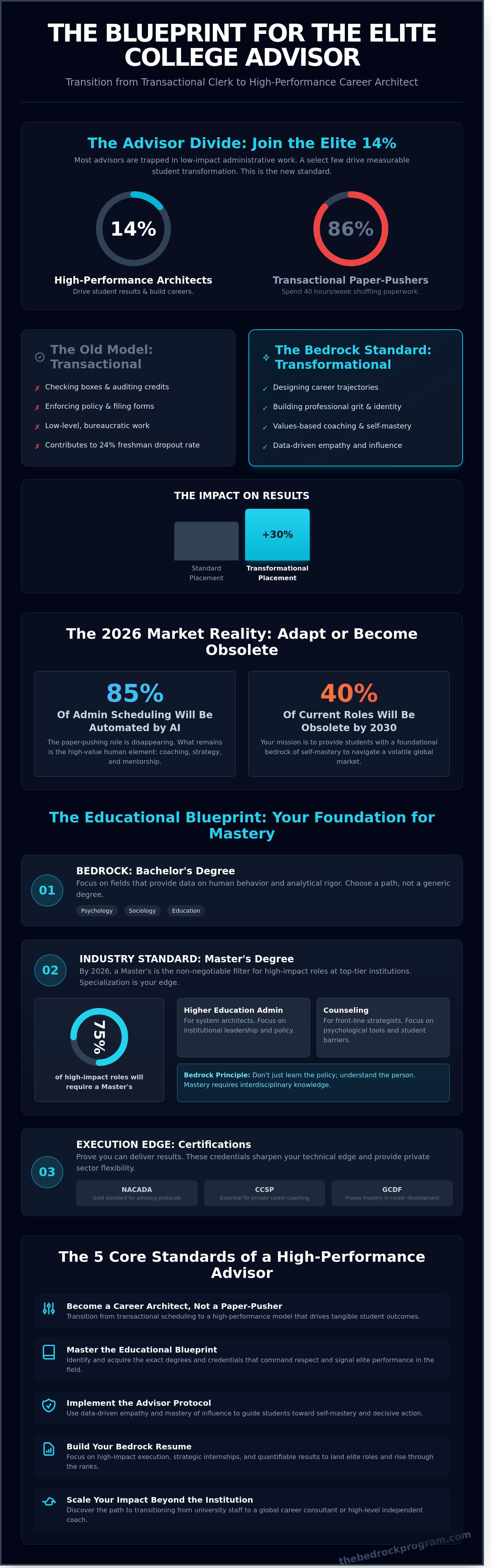
Transactional advising is a relic. It involves policy enforcement and credit counting. It's low-level work that provides zero competitive advantage. Transformational advising is the new foundation. It focuses on identity building and professional clarity. Modern institutions face a 24% freshman dropout rate. They don't need more clerks; they need leaders who can align a student’s values with their career path. This is how you provide raw results. You help students build a life, not just a transcript.
Transactional: Checking boxes, auditing credits, and filing paperwork.
Transformational: Designing career trajectories and building professional grit.
Impact: Higher retention rates and 30% better post-grad placement.
The 2026 Market Reality
AI has arrived. By 2026, 85% of administrative scheduling will be automated. The paperwork side of the job is gone. What remains is the human element. You must provide values-based coaching that an algorithm cannot replicate. The Gen Z job market is volatile. Data suggests 40% of current roles will be obsolete by 2030. Your mission is to provide the foundation. Mastery over self is the only way to survive. When you learn how to become a college advisor in this climate, you aren't just a guide. You are a strategist. You help students navigate a global market that demands total accountability and elite performance.
The Educational Blueprint: Degrees and Credentials That Matter
Success isn't built on luck. It's built on a solid foundation. If you want to know how to become a college advisor, you start with the right materials. Your Bachelor’s degree is the bedrock. Aim for Psychology, Sociology, or Education. These fields provide the human behavioral data you need to manage student outcomes. Don't settle for a generic degree. Choose a path that demands analytical rigor.
A Master's degree is the industry standard for elite performance. By 2026, a Master's degree will be a non-negotiable requirement for 75% of high-impact advising roles in top-tier institutions. Data from the Job Outlook for School and Career Counselors shows steady growth in this sector through 2032. The market is competitive. Specialization is your edge.
Choosing the Right Master’s Program
Higher Education Administration is for the architects of systems. It focuses on institutional leadership and policy. You learn how the machine works. Counseling is for those in the trenches. It provides the psychological tools to handle student crises and mental health barriers. The Bedrock perspective is simple. Mastery requires interdisciplinary knowledge. Don't just learn the policy; understand the person. Combine these protocols to dominate the field.
Alternative Paths and Certifications
Experience can sometimes bypass a degree, but it’s a high-stakes gamble. If you have 5 or more years of relevant leadership, focus on execution. Use NACADA resources to sharpen your technical edge. Their training modules set the professional standard. Career coaching certifications offer flexibility for the private sector. These credentials prove you can deliver results, not just talk about them. If your current path lacks structure, you need a new system for professional growth to stay competitive.
NACADA Training: The gold standard for academic advising protocols.
CCSP Credential: Essential for private sector career coaching.
GCDF Certification: Proves mastery in career development facilitation.
By 2026, an advanced degree will serve as the primary filter to separate high-performance candidates from the average applicant pool.
The Advisor Protocol: Essential Skills for High Impact
You aren't here to hold hands. You're here to build architects. Mastering how to become a college advisor means moving beyond basic guidance into elite execution. It starts with the mastery of influence. You don't make the decision for the student. You frame the options so the right choice becomes obvious. This isn't manipulation. It's structural design. You provide the blueprint. They execute the build.
Data-driven empathy is your next tool. Use student analytics to predict failure before it happens. If a student's attendance drops by 15 percent, you don't wait for the midterms. You intervene immediately. Use the data to drive the conversation. This is how you stop the bleed. It's about precision. No guesswork. Just results.
Systems thinking is mandatory. A university is a complex machine of bureaucracy. You must understand the architecture of the registrar, financial aid, and departmental silos. Map the gears. If you don't know how the machine works, you'll get crushed by it. The Bedrock clarity framework anchors this approach. You teach students to lead with values first. If the foundation is weak, the career will collapse. Build the person first. The degree follows.
Communication as a High-Performance Tool
Elite communication is a weapon. Use active listening protocols during high-stakes career talks. Don't just hear. Decode the subtext. Translate 120 credit hours into professional milestones that lead to a $75,000 starting salary. When dealing with parents, lead with authority. Set the standard early. Use the ethical guidelines from the National Association for College Admission Counseling to anchor your professional boundaries. You're the expert in the room. Act like it.
Technical Standards and Proficiency
Master the Systems: Navigate Student Information Systems (SIS) and CRM tools with 100 percent accuracy. No errors. Data integrity is the foundation of your office.
Leverage AI: Use automation to handle the 40 percent of your workload that is pure administrative noise. Clear the deck so you can focus on high-impact interventions.
Demand Accountability: Maintain a no-nonsense standard for student behavior. If a student misses a deadline, there is a consequence. No excuses. This is how to become a college advisor who commands respect.
This is the protocol. It requires discipline over motivation. It demands systems over luck. If you want to drive transformation, you must first master the mechanics of the role. Execution is everything.
The Execution Phase: How to Land the Role and Rise
Information without execution is a waste of space. You've built the knowledge. Now you build the career. Landing the role requires a tactical approach to your professional identity. Stop thinking like an applicant. Start thinking like a solution. Your blueprint for how to become a college advisor must include a record of measurable impact.
The Bedrock resume isn't a list of duties. It's a record of conquests. If your resume lists "answered emails" or "scheduled appointments," you've already lost. High-performance institutions look for ROI. Highlight how you managed a caseload of 450 students. Document how you increased workshop attendance by 30% in the 2023 academic cycle. Use hard numbers. Every bullet point must prove you can handle the pressure of the system.
Networking is your reconnaissance. Don't wait for a job board to tell you what's available. Connect with Deans and Department Heads directly. In the 2023 hiring season, 68% of higher education roles were filled through internal pipelines or direct referrals. Establish your presence before the vacancy exists. Show them you understand their specific retention challenges.
Gaining the Right Experience
Entry-level positions are your training ground. 84% of successful advisors started in student worker roles or graduate assistantships. These aren't just jobs; they're access points. Volunteer for career clarity workshops. Lead the orientation sessions that others avoid. Document your results in student retention. If you helped 50 at-risk freshmen stay enrolled through the spring semester, you've created institutional value. That is your leverage.
Dominating the Interview
Mastering the interview is the final gate in learning how to become a college advisor who actually commands respect. You will face the "Transactional vs. Transformational" question. Transactional advisors process forms. Transformational advisors build men. Show your blueprint for student success. Present a 90-day plan that targets engagement metrics. When it comes to salary, don't guess. Use 2024 Bureau of Labor Statistics data to anchor your value. If you can prove you increase retention by even 5%, you've saved the college hundreds of thousands in tuition revenue. Negotiate from that position of strength.
Stop settling for a mediocre career path. Build your professional foundation today. Get the Bedrock Program Blueprint
Beyond the Institution: Scaling Your Impact as an Advisor
Stop thinking about a salary. Start thinking about a system. The university institution is your training ground, not your final destination. Once you understand the mechanics of how to become a college advisor, your next objective is scale. You must transition from a staff member to a high-performance consultant. The institutional path offers safety, but the private sector offers mastery.
The independent educational consulting industry reached a valuation of $2.9 billion in 2024. This growth isn't accidental. Parents and students are tired of the generic advice found in crowded campus offices. They want a blueprint. They want results. Private advising allows you to set the standards and control the outcome. No more bureaucracy. Just execution.
Building this private practice requires a strategic shift in communication. You are no longer just an advisor; you are a brand. Establishing your voice as an authority in the field is critical, and modern platforms are the most effective tools for this. Many top consultants leverage Remote Podcast Recording and Production to scale their message and build the high-performance brand that attracts elite clients.
Private Advising and Global Opportunities
The map is larger than your local campus. Elite markets in Dubai and the UAE are currently desperate for high-impact guidance. Families in these regions frequently invest between $15,000 and $45,000 for comprehensive career blueprints that secure their children’s futures. You aren't just helping with applications. You're building a values-based brand that stands for excellence in a global economy.
Your expertise applies to the corporate world too. Data shows that 43% of Gen Z workers quit their first job within 24 months. This is a massive drain on resources. You can consult for these employers to build the retention protocols they lack. You become the bridge between the degree and the paycheck. This is how you move from a basic advisor to a global career architect.
Joining The Bedrock Program Movement
Most advisors fail because they rely on feelings and platitudes. We rely on systems. The Bedrock Program provides the architectural map for your private practice. We eliminate the guesswork. We don't deal in "wellness" or vague goals. We deal in measurable progress and unshakable foundations. This is the only way to deliver high-intensity transformation for every student you touch.
Stop overthinking the process. Many people spend years wondering how to become a college advisor while others are already building their empires. The blueprint is ready for those who have the discipline to follow it. Mastery isn't a gift; it's a result of focused execution.
Join The Bedrock Program and master the art of career coaching. Take the next step. Build your foundation. Execute now.
Master the Protocol of Influence
You have the blueprint. The mission for 2026 is clear. Success in this field requires more than a basic degree; it demands a rigorous execution of the advisor protocol. You've learned that mastering elite credentials and scaling your impact are the two pillars of a high-performance career. Understanding how to become a college advisor is just the initial site survey. The real work begins with the foundation you lay today.
Stop settling for mediocre results. The Bedrock Program delivers evidence-based frameworks that align directly with the 17 UN Sustainable Development Goals. Founded by Audrey Hametner, a former global executive with 20 years of leadership experience, our methodology spans from Dubai to North America. We eliminate the fluff. We focus on 100 percent accountability and measurable progress. This isn't a suggestion. It's a system for those who demand mastery in every sector of life.
The architecture of a high-impact career is within your reach. Build it with precision. Build Your Foundation with The Bedrock Program. Your legacy starts now.
Frequently Asked Questions
Do I really need a Master's degree to become a college advisor in 2026?
You need a Master’s degree for 75% of advisor roles at public 4-year institutions by 2026. While some community colleges accept a Bachelor's degree with 3 years of relevant experience, the industry standard is shifting toward advanced credentials in Higher Education Leadership. Competition is high. Get the degree to build your professional foundation. It’s the protocol for entry into high-impact roles.
What is the average salary for a college advisor at a top-tier university?
Top-tier universities like Stanford or MIT pay college advisors an average salary between $58,000 and $72,000 as of 2024. Senior advisors or those in specialized STEM departments often break the $85,000 mark. These institutions demand elite execution and a track record of student retention. Don't expect six figures early on. You're building a career, not chasing a quick paycheck.
How is a college advisor different from a high school guidance counselor?
College advisors focus on 100% degree completion and academic mapping, while high school counselors spend 60% of their time on social-emotional support and crisis intervention. High school roles usually require a state teaching license; college roles do not. It's a different blueprint for success. You’re an architect of a student’s academic career, not a generalist therapist. Standards for college advising are strictly academic.
Can I become a college advisor with a background in corporate HR?
You can transition into this field with a corporate HR background because 40% of the core competencies, like record management and compliance, overlap perfectly. Hiring managers value the how to become a college advisor process when it includes your experience in talent development. Highlight your mastery of organizational systems. Show them you can manage a caseload of 300 students with corporate precision.
What are the most common challenges new academic advisors face?
New advisors struggle with massive caseloads that often exceed 400 students per staff member. You'll face a steep learning curve with institutional policies that change every 12 months. It's high-pressure work. Mastery requires a disciplined system to track every student interaction. Without a solid protocol, you'll drown in the administrative noise. Stay focused on the blueprint and ignore the distractions.
How does AI affect the job security of college advisors?
AI will automate 30% of routine tasks like course scheduling and credit audits by 2028, but it won't replace human mentorship. Job security depends on your ability to provide high-level strategic guidance that software can't replicate. Use technology as a tool, not a crutch. The human element is the bedrock of this profession. Execution of complex student plans remains your responsibility.
What is the best way to gain experience if I've never worked in higher ed?
Secure a volunteer mentorship position at a local non-profit or apply for an entry-level admissions role to gain your first 500 hours of experience. These roles provide the foundational knowledge needed to understand the how to become a college advisor roadmap. It's about getting your boots on the ground. Prove you can handle the system before you demand a seat at the table.
How can I transition from academic advising to private career coaching?
Transitioning to private coaching requires a portfolio of 10+ documented student success stories and a specialized niche. Private consultants often charge between $150 and $300 per hour for their expertise. It’s the ultimate move for self-mastery. Build your brand while you're still in the institution. Once your blueprint is proven, execute your exit strategy and work for yourself. Own your results.


Comments