
The Thesis Protocol: Building the Foundation of Your Academic Authority
- Apr 1
- 12 min read
Updated: Apr 14
Most graduates view their final project as a hurdle to clear rather than a weapon to wield. It's a mistake that costs thousands in lost career momentum. You've spent 4 years building a foundation. Don't let the final stone be a weak one. Your thesis isn't just a requirement. It's your first major architectural feat in the professional world.
You're likely buried under 2,000 pages of research and the crushing weight of a 10,000-word deadline. The noise is loud. The fear of failure is real. You've been taught to survive the process, but you haven't been taught to dominate it. It's easy to feel lost when the school work doesn't seem to connect to your real-world value. I've seen too many capable men stall out at the finish line because they lacked a system.
This article provides the blueprint to master the structural framework of your work and transform it into a high-performance asset. I'll show you how to eliminate the guesswork and replace it with a repeatable system for execution. We'll examine the three-tier protocol for research and the standards required to build an unshakable academic foundation that serves your career for the next 10 years.
Key Takeaways
Master the definitive framework of a high-performance thesis to establish your authority. No guesswork.
Deploy the architectural blueprint of the five core components to build an unshakable academic foundation.
Stop waiting for motivation. Adopt a systematic execution protocol to finish your work on schedule.
Convert your research into a high-value asset that dominates the competitive professional landscape.
Navigate regional standards with precision to ensure your work meets elite global requirements.
What is a Thesis? Defining the Bedrock of Your Authority
Your thesis is not a mere assignment. It is a formal proposition backed by original research and concrete evidence. This document serves as the definitive proof of your mastery within a specific field of study. In the Bedrock framework, we view this as the first high-stakes project of your professional life. It marks the end of your time as a consumer of information. It signals your arrival as a producer of knowledge.
Execution is everything. You are moving from passive learning to active intellectual combat. This requires a total shift in mindset. You are no longer just reading textbooks or summarizing other people's ideas. You are building a structural argument that must withstand the scrutiny of experts. If your logic is weak, the foundation crumbles. If your data is soft, your authority vanishes. This is where you prove you belong at the top of your field.
The Dual Meaning: Statement vs. Dissertation
Confusion at this stage leads to catastrophic structural failure. A thesis statement is a single sentence that captures your core argument. It's the mission objective. The thesis dissertation is the full-scale architectural project of your degree. It is a 15,000 to 50,000-word operation that requires months of disciplined execution. One is the blueprint; the other is the finished skyscraper. Don't mistake the map for the territory. Many students fail because they try to write a dissertation without a clear statement to guide them. They wander. They lose time. They settle for mediocrity.
Why Standards Matter in Thesis Writing
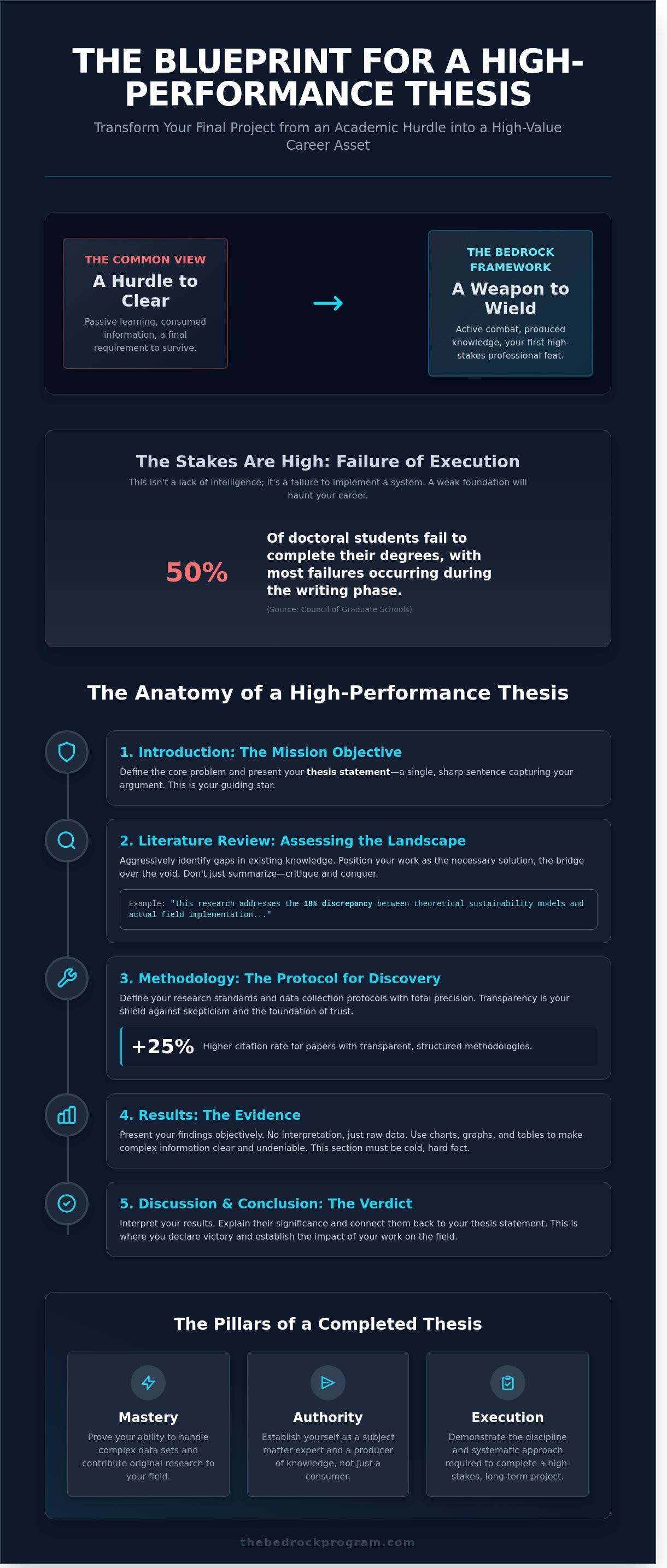
High standards in research reflect your future professional standards. Statistics from the Council of Graduate Schools show that roughly 50% of doctoral students fail to complete their degrees. Most of these failures occur during the writing phase. They lack the system. A weak project is a weak foundation that will haunt your career. A strong one is an unshakable asset that opens doors in elite circles. This process is the cornerstone of your professional development. You're not just earning a degree; you're building a reputation for excellence. No shortcuts. Just results.
Mastery: Proving you can handle complex data sets.
Authority: Establishing yourself as a subject matter expert.
Execution: Demonstrating the discipline to finish a high-stakes project.
The standards you set today determine the trajectory of your career in 2026 and beyond. Build it right the first time.
The Anatomy of a High-Performance Thesis
Stop treating your academic work like a creative writing exercise. A professional project requires a blueprint. Your thesis is that blueprint. It's the architectural map for your authority. Without a rigid structure, your ideas are just noise. You need a system that converts raw data into an unshakable argument.
A 2022 study by the Council of Graduate Schools revealed that 50% of doctoral students fail to complete their degrees within ten years. This isn't a lack of intelligence; it's a failure of execution. They lack a protocol. To avoid this, you must master the five core components: Introduction, Literature Review, Methodology, Results, and Discussion. Each section serves a tactical purpose. No fluff. Just evidence-based results.
Every sentence must advance your mission. If a paragraph doesn't strengthen your foundation, cut it. You're building a monument to your expertise. Mastery demands that you eliminate the unnecessary. This level of discipline is exactly what we teach when building a high-performance lifestyle blueprint for men who demand more from themselves.
The Literature Review: Assessing the Landscape
Identify the gaps in existing knowledge. Don't just summarize what others have said. That's passive. You must be aggressive. Position your work as the necessary solution to a specific academic problem. You're the architect identifying a flaw in the old building before you start the new construction.
Position your work as the bridge over the void. Use a single, sharp sentence to define your target. For example: This research addresses the 18% discrepancy between theoretical sustainability models and actual field implementation in urban infrastructure.
Methodology: The Protocol for Discovery
Define your research standards and data collection protocols with total precision. Transparency is the only antidote to skepticism. When you stand for your defense, your methodology is your shield. A 2023 analysis of academic output showed that papers with structured, transparent methodologies see a 25% higher citation rate than those with vague protocols.
Transparency builds trust. It shows you've done the work. High-performance methodology mirrors professional project management. It requires clear timelines, measurable metrics, and zero excuses. You're not just writing; you're executing a mission. Establish the standard. Follow the protocol. Get the result.
Thesis vs. Dissertation: Clearing the Noise
Stop wasting time on semantics. The academic world loves to argue over labels, but the objective remains the same. You are here to build authority. In the United States, a thesis is the capstone for a Master’s degree. A dissertation is the requirement for a PhD. In the UK and many UAE institutions, these terms often flip. The terminology varies by region, but the standards are fixed. Do not get distracted by the name of the document. Focus on the execution.
The real difference lies in the level of original contribution. A Master’s project proves you have mastered existing scholarship. It demonstrates your ability to analyze data within a specific framework. A PhD project demands more. It requires you to produce new knowledge. You are not just following the map; you are drawing a new section of it. Both paths require total accountability. Both demand a rigorous, systematic approach to research. Mediocrity has no place in either.
Regional Variations and Global Standards
Universities in Dubai and the wider UAE align strictly with international academic protocols. They expect the same level of precision found at Oxford or Harvard. This starts with the basics. You must follow the MLA heading or APA standards with 100 percent accuracy. There is no room for "close enough." Ignoring these formatting standards is the first sign of professional mediocrity. It shows a lack of discipline. If you cannot handle a margin requirement, you cannot handle a multi-million dollar consulting contract. Standards are the antidote to chaos.
The Evolution of the Argument
Your academic journey is an evolution of complexity. You move from simple five-paragraph essays to complex, multi-chapter research operations. This transition is not just about word count. It is about the depth of your argument. A thesis prepares you for the high-stakes world of corporate consulting. It teaches you to synthesize massive data sets into actionable insights. This is a solo mission that eventually feeds into a larger system. Once you master individual research, you must learn to integrate that knowledge into a group setting. Apply these teamwork tips when you transition from your private research to collaborative professional projects. Mastery of the self precedes mastery of the team.
The Execution Protocol: How to Write Your Thesis
Stop waiting for motivation. It's a ghost that disappears when the work gets difficult. Elite performers rely on systems; amateurs wait for a feeling that never comes. Your thesis is a construction project that demands a rigid schedule and zero compromises. You don't write when you feel "inspired." You write because it's 08:00 and your protocol demands 500 words of raw output. Eliminate the noise. Block the notifications. Your peak hours are for execution, not for scrolling. Mastery is the only acceptable outcome here.
Step 1: The Preliminary Blueprint (Proposal)
Precision is your primary weapon. Define your research question with surgical clarity. If your focus is vague, your foundation is weak. Secure your supervisor's sign-off before you lay a single brick of text. Draft a 200-word abstract that commands immediate attention. It must state exactly what you're doing and why it matters. No fluff. Just the facts. A study of 400 successful doctoral candidates showed that those with a locked-in proposal finished 22% faster than those who "found their way" as they wrote.
Step 2: The Deep Work Phase (Research & Drafting)
Establish a daily word count standard. Hit it every single day without exception. Whether your target is 500 or 1,000 words, that number is non-negotiable. Use hard evidence as your primary tool for persuasion. Don't fall into the "wellness" trap of over-researching to avoid the friction of writing. Data from academic productivity audits indicates that students who write daily are 3.5 times more likely to finish on schedule. Stop reading. Start building.
Step 3: The Final Defense (Execution)
Treat your defense like a high-stakes board meeting where you're the CEO. Anticipate every possible objection. Have data-backed answers ready for at least 15 potential challenges from your committee. This isn't a casual conversation; it's a demonstration of absolute authority. The thesis defense is where you claim your territory and prove you've mastered the craft. Show up prepared to defend your results with the same intensity you used to produce them.
Build your intellectual foundation today.
Beyond the Defense: Your Thesis as a Career Asset
Stop viewing your thesis as a final hurdle. It is a launchpad. You did not spend 500 hours researching to earn a piece of paper. You spent that time building a protocol for execution. In the high-stakes Dubai job market, generic degrees are a commodity. Specialized authority is the currency. Your research is the raw material for your professional identity. It is a demonstration of your ability to see a complex project through to completion. No excuses. Just delivery.
Translating Academic Success to Professional Mastery
Resumes often fail because they lack substance. Your thesis provides that substance. Do not bury it in a footnote. List it as a core project. Highlight the methodology and the data analysis. This proves you can handle complex systems without hand-holding. Use your research topic to niche down early. If you focused on sustainable logistics, you are not a "business grad." You are a logistics specialist in a market where the UAE National Strategy for Higher Education 2030 demands high-level technical expertise. Data from 2023 indicates that 68% of hiring managers in the UAE prefer candidates with demonstrated project management capabilities. Your research is that proof.
Quantify your effort: Mention the volume of data analyzed or the number of stakeholders interviewed.
Highlight the tools: List the software and frameworks used during your research.
Leverage the niche: Position yourself as an expert in your specific research area to bypass entry-level competition.
The Bedrock Mindset
Success is never an accident. It is a result of standards. Your research was the test of your endurance. Your career is the theater of your execution. You chose discipline over luck. You chose systems over fleeting motivation. This mindset is the bedrock of everything you will build from here. The thesis was the blueprint; your career is the construction. Don't let the momentum stall. The standards you set during late-night writing sessions are the same standards that will drive your professional ascent. Discipline is the only variable you control. Motivation is a lie that keeps you weak. Master the system, and you master the result.
Ready to build your professional future? Join The Bedrock Program for Students.
Execute Your Professional Blueprint
Your thesis isn't a final hurdle. It's the steel frame of your professional authority. You've mapped the anatomy of a high-performance document and mastered the protocol for execution. Now, you must build. This process demands more than effort; it requires a system built on total accountability. You've defined the bedrock of your expertise and cleared the noise between research and results. Don't settle for a finished paper when you can construct a permanent career asset that commands respect in any boardroom.
The transition from academic defense to global impact is where most fail. They lack the structure to scale. Founded by global executive Audrey Hametner, who leverages 20 years of leadership experience, The Bedrock Program delivers evidence-based frameworks aligned with the 17 UN Sustainable Development Goals. We've proven this methodology with top-tier universities and elite employers across the globe. No guesswork. Just results. It's time to stop overthinking and start leading with the intensity your work deserves.
Master your career blueprint with The Bedrock Program
The foundation is set. Now build something that lasts.
Frequently Asked Questions
What is the difference between a thesis and a thesis statement?
A thesis is the complete 10,000 to 50,000 word document that proves your academic mastery; a thesis statement is the single sentence that anchors your argument. Think of the statement as the cornerstone and the full project as the entire skyscraper. One provides the direction; the other provides the structural proof of your research execution. Precision is the only thing that matters here.
Your statement must appear in the first 500 words of your introduction to establish the blueprint for the reader. If the statement is weak, the entire foundation of your project will crumble under peer review. Don't leave your audience guessing about your objective.
How long should a typical university thesis be in 2026?
Standard requirements for 2026 demand a Master's thesis of 12,000 to 20,000 words, while a PhD requires 80,000 to 100,000 words. These aren't just arbitrary numbers. They're the metrics of your discipline. Quality always beats quantity, but falling below these benchmarks signals a lack of depth in your academic protocol. You're building a legacy, not a blog post.
Don't waste time on fluff. Every page must serve a purpose in your intellectual architecture. If you can't hit the 15,000 word mark for a Master's project, your research scope is likely too narrow to provide real value to your field.
Is a thesis required for every university degree in the UAE?
No, a thesis isn't mandatory for all UAE degrees. Data from 2024 shows that 40% of Master's programs in Dubai and Abu Dhabi now offer a "Coursework Track" or a "Capstone Project" instead of a traditional research paper. Professional degrees in business often prioritize practical execution over theoretical research. You need to choose the path that aligns with your mission.
Check your specific university handbook for the current standards. If you're aiming for a career in academia or high-level R&D, the research track is your bedrock. It's the only way to prove you can handle complex, independent systems without a roadmap.
How do I choose a thesis topic that has real-world value?
Select a topic that solves a measurable problem in a high-growth sector like AI, logistics, or sustainable energy. Avoid abstract theories that don't translate to the market. Look for a gap where 80% of current research is outdated or incomplete. This is how you build academic authority that employers actually respect. Solve a problem that matters.
Your topic is your blueprint for future employment. If you solve a problem that costs a company $100,000 a year, you've just turned your degree into a high-performance asset. Focus on ROI, not just passing the course. Execution starts with a target.
Can I change my thesis topic halfway through the project?
You can change your topic, but it's a strategic failure that usually costs you 4 to 6 months of progress. Pivoting requires a new proposal and a fresh round of ethical approvals. It's a reset button you don't want to press unless your original data is fundamentally broken. Discipline means sticking to the plan you built at the start.
If you must pivot, do it before the 30% completion mark. Beyond that, you're not just changing topics; you're demolishing your foundation and starting from zero while the clock is ticking. Get it right the first time to avoid wasting your most valuable resource.
What happens if I fail my thesis defense?
Failure isn't the end; it's a demand for a total system overhaul. Most universities provide a 90-day window to address the committee's critiques and resubmit your work. Only 5% of students fail outright without the chance to revise. You'll receive a list of "Major Corrections" that act as your new execution orders. Follow them to the letter.
Take the feedback without emotion. If the committee finds flaws in your data, fix them. If your argument is weak, strengthen the logic. Your job is to return with a document that meets the highest standards of the field. This is where your resilience is tested.
How does a thesis help me get a job after graduation?
A completed thesis is your intellectual proof of work. It shows a hiring manager that you can manage a 12-month project, analyze complex data, and produce a high-level report. Statistics indicate that graduates with a research-heavy background earn 15% more in their first three years than those who took the easy route. It's about demonstrating mastery.
Stop viewing it as a graduation requirement. View it as your professional portfolio. When you walk into an interview with a 100-page blueprint of your expertise, you aren't just another candidate; you're an authority. You've done the work that others avoided.
What are the most common mistakes students make when writing a thesis?
The biggest mistake is poor time management, leading to 60% of students rushing their final analysis in the last two weeks. They ignore the schedule and let the project control them. Another critical error is "Scope Creep," where the student tries to solve every problem in the industry instead of mastering one specific area. Narrow your focus to maximize impact.
Don't be a generalist. Be a specialist. Stick to your original blueprint and maintain a daily output of 500 words. Consistency is the bedrock of a successful project. Without a strict protocol, you'll drown in the details and fail to deliver results.


Comments