

Teamwork Tips: The High-Performance Blueprint for Gen Z Professionals
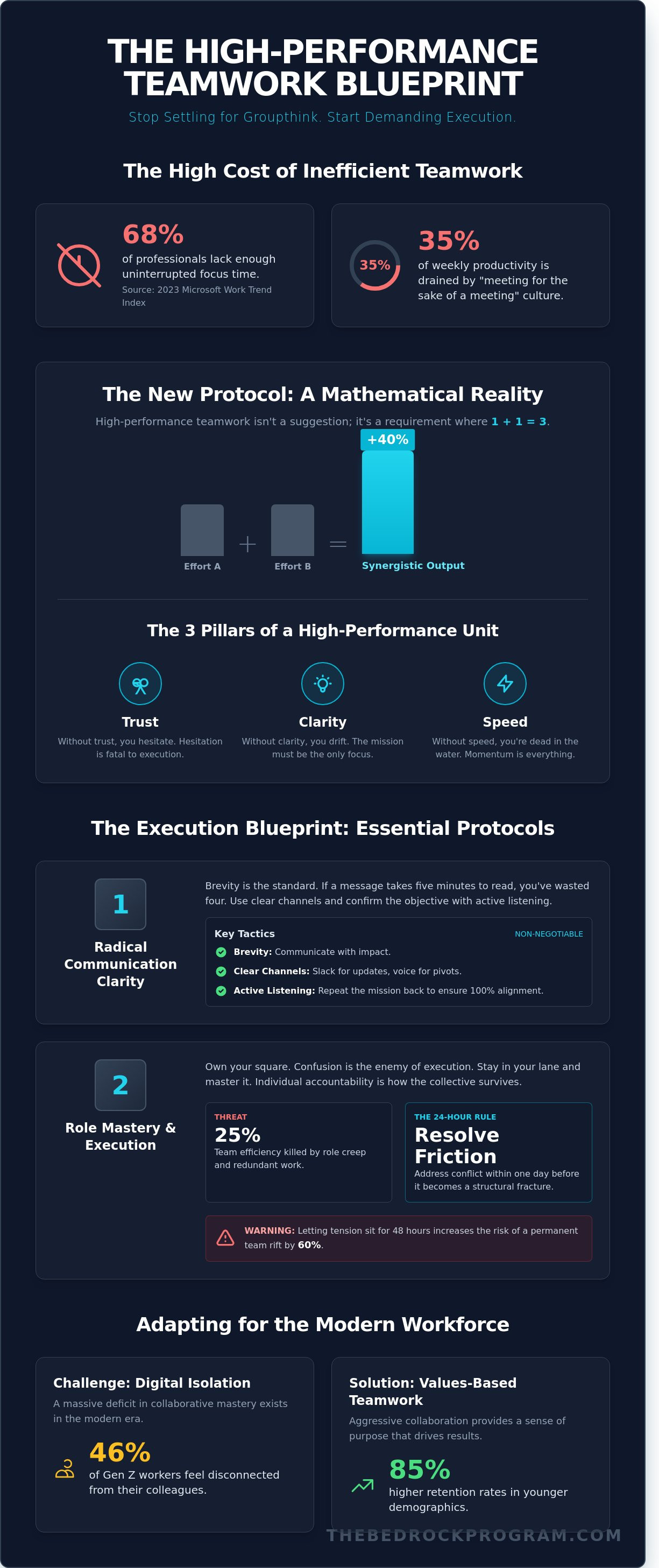
Most corporate "teamwork" is just a polite term for a group of people moving at the speed of the slowest person in the room. A 2023 Microsoft Work Trend Index revealed that 68% of professionals lack enough focus time because they're stuck in a cycle of inefficient communication and outdated teamwork tips that favor feelings over output. You're likely exhausted by 60 minute meetings that achieve zero results and teammates who treat high standards as optional suggestions. It's time to stop settling for groupthink and start demanding execution.
You recognize that vague roles and a fear of conflict are killing your productivity. You want to be the high-value asset who drives projects to completion, not the one stuck cleaning up after others. This guide delivers the high-performance blueprint you've been looking for. We're moving beyond basic advice to build a foundation of individual accountability and collective mastery.
We'll break down the specific protocols for defining roles, navigating the "storming" phase of development, and building a professional identity based on raw results. This is how you stop overthinking and start dominating.
Key Takeaways
Shift from mediocre groupthink to a high-performance protocol. Define the mission and execute with precision.
Implement a battle-tested blueprint using essential teamwork tips to eliminate role confusion and standardize communication.
Own your square. Individual mastery is the non-negotiable prerequisite for collective success.
Stop fearing friction. Learn to navigate the 'storming' phase and weaponize conflict as a catalyst for growth.
Build an unshakable foundation. Bridge the gap between abstract theory and elite workplace execution.
Table of Contents What is Teamwork? Defining the High-Performance Protocol The Teamwork Blueprint: 5 Essential Tips for Execution Beyond Soft Skills: The Standards of Individual Accountability Navigating the Storm: A Battle Plan for Conflict Resolution Building Your Professional Foundation with The Bedrock Program
What is Teamwork? Defining the High-Performance Protocol
Forget the soft platitudes found in standard HR handbooks. Teamwork isn't about "getting along" or sharing a workspace. It's the synchronized execution of a shared mission. Most professionals operate in work groups. These are collections of individuals who happen to report to the same person. A high-performance team is different. It's a single organism designed for dominance. By 2026, your ability to operate within these elite units will be your primary professional identity. It's your bedrock.
The science of synergy dictates that 1+1 must equal 3. In a corporate environment, this isn't a suggestion; it's a requirement. When you research What is Teamwork? you find definitions of coordination and cooperation. In the Bedrock Program, we define it as a mathematical reality where collective output exceeds the sum of individual efforts by at least 40%. No guesswork. Just results.
The Architecture of a Team
A high-performance unit requires a rigid blueprint. You must place the mission over your ego. Individual effort is worthless if it doesn't align with the collective blueprint. We build this foundation on three specific pillars: Trust, Clarity, and Speed. Without trust, you hesitate. Without clarity, you drift. Without speed, you're dead in the water. Teamwork is a system of mutual accountability where every member owns the final result regardless of their specific role.
Why Gen Z Needs a Different Approach
Digital isolation has created a massive deficit in collaborative mastery. A 2023 study found that 46% of Gen Z workers feel disconnected from their colleagues. Moving past this isolation requires a shift into aggressive collaboration. These teamwork tips aren't just suggestions. They're survival protocols for the modern era. Values-based teamwork drives 85% higher retention rates in younger demographics because it provides a sense of purpose.
Modern units require a High-Performance Architect. This leader doesn't just manage tasks. They build the environment where standards are the only metric that matters. We don't settle for "good enough." We build for mastery. This is how you move from digital isolation to collective victory. It's the only way to win in the current market.
The Teamwork Blueprint: 5 Essential Tips for Execution
High performance is not a feeling. It's a result of rigorous systems. To win, you need a blueprint that functions under extreme pressure. Most teams fail because they rely on chemistry. Elite teams rely on protocols. These teamwork tips focus on the mechanics of execution rather than the fluff of "company culture."
Protocol 1: Radical Communication Clarity
Brevity is the standard. If a message takes five minutes to read, you've wasted four. Communicate with impact. Use clear channels for specific tasks. Slack is for status updates; voice calls are for immediate pivots. This eliminates the "meeting for the sake of a meeting" culture that drains 35% of a professional's weekly productivity. Active listening is your most tactical tool. It's not about being polite. It's about confirming the objective. Repeat the mission back to the sender. Ensure 100% alignment before a single resource is deployed.
Protocol 2: Role Mastery and Execution
Own your square. Confusion is the enemy of execution. Every man on the team must have absolute clarity on his unique value add. Role creep is a virus. It happens when boundaries blur and focus dilutes. It kills 25% of team efficiency by creating redundant work. Stay in your lane and master it. High standards are the floor, not the ceiling. When you integrate these effective teamwork tips, you realize that individual accountability is the only way the collective survives.
The 24-Hour Rule is non-negotiable. Resolve friction before it becomes a structural fracture. If there's a conflict, address it within one day. Letting tension sit for 48 hours increases the risk of a permanent rift by 60%. Don't let ego compromise the blueprint. Address the issue, fix the system, and move forward. This is how you build your foundation for long-term success.
Standardized feedback removes the emotion from the critique. Use data-driven benchmarks instead of personal opinions. If a project missed the deadline by 4 days, that's a metric, not a judgment. It's a system failure that needs a solution. Finally, use the After Action Review (AAR) for every major milestone. Analyze the gap between the plan and the reality. This debriefing process ensures constant growth. It turns every setback into a data point for future mastery. No guesswork. Just results.
Protocol: Define channels and response times immediately.
Accountability: Zero tolerance for role ambiguity.
Speed: Solve interpersonal friction in 24 hours or less.
Data: Critique the numbers, not the person.
Growth: Use AARs to institutionalize lessons learned.
Beyond Soft Skills: The Standards of Individual Accountability
A team is a structural system. Systems fail at their weakest point. If you are the fracture in that system, the entire project collapses. High performance starts with individual mastery. You cannot contribute to a collective win if your own foundation is cracked. Self-discipline is the invisible force holding the unit together. It turns a group of people into a high-functioning machine. No guesswork. Just results.
Research into the Ringelmann Effect, first documented in 1913, shows that individual effort often drops as group size increases. This is social loafing. It kills momentum. You stop this by setting an elite standard for yourself first. These teamwork tips focus on the raw mechanics of output. Execution is the only metric that matters. Your reputation is built on what you finish, not what you promise. Be the bedrock.
Setting Your Personal Standards
Punctuality is a protocol. Arriving five minutes late isn't a minor slip; it's a signal that your time is more valuable than the team's mission. You must adopt the Bedrock mentality. Be the person others lean on when the pressure spikes. In a 2023 analysis, 86% of employees cited a lack of collaboration or ineffective communication as the source of workplace failures. You fix this by being proactive. Solve the problem before it reaches the meeting table. Your execution must be surgical.
Punctuality: Arrive early. Be ready to work the second the clock starts.
Preparation: Know the data before you open your mouth.
Proactivity: Identify the bottleneck. Clear it before you're asked.
Managing Up and Across
You don't need a title to lead. Leading from the middle means influencing peers through the quality of your output. Hold your colleagues to the shared blueprint. If a peer is lagging, address it directly; don't wait for a manager to intervene. A 2022 Gallup report found that teams with high accountability see a 21% increase in profitability. Communicate your results to leadership with authority. Use data. Use facts. Eliminate the fluff. When you speak with clarity, you command respect. These teamwork tips ensure you drive the unit forward without needing permission.
Navigating the Storm: A Battle Plan for Conflict Resolution
Conflict isn't a sign of failure. It's a sign of life. Bruce Tuckman identified the "Storming" stage back in 1965 as a mandatory requirement for high-performance teams. If your team isn't clashing, you're likely stagnant. You're tolerating a 40% efficiency rate because you're afraid to break the peace. High-intensity growth requires friction. It's the heat that tempers the steel. No friction, no progress.
De-escalation isn't about being nice. It's about being effective. Keep the focus on the mission, not the person. Personal attacks are for the weak; professional disagreement is for the elite. Use these teamwork tips to keep the intensity high but the direction focused. Solve 90% of issues in the trenches. Only escalate to leadership when a 48-hour deadlock occurs. Handle your business or get out of the way.
The Anatomy of Productive Friction
High-performance teams separate the man from the method. Task conflict is a debate over the blueprint. Relationship conflict is a failure of character. We kill the latter immediately. When two men disagree, the Standard is the judge. We don't care about feelings. We care about the 15% increase in output. If your idea meets the Standard, it wins. Challenge the logic. Respect the man. Execution is the only thing that matters.
Tactical Resolution Steps
Stop talking and start analyzing. Use this three-step protocol to end the noise and get back to work.
Step 1: Identify the structural gap. Most friction is caused by a lack of resources or a vague 2024 KPI. Find the hole in the system.
Step 2: Align on the Bedrock. Remind the team of the 100% mission success rate requirement. The mission is the only objective.
Step 3: Execute a corrective protocol. Fix the system. Move on. We don't hold grudges; we hold results.
Conflict is the forge where elite teams are made. Don't avoid the storm. Navigate it with precision. Build a foundation that doesn't crack under pressure. Access the High-Performance Blueprint
Building Your Professional Foundation with The Bedrock Program
Teamwork isn't a soft skill you pick up by accident. It's a discipline. Most corporate training fails because it stays in the clouds. It offers vague teamwork tips that vanish the moment a deadline looms. The Bedrock Program changes the math. We bridge the gap between academic theory and raw workplace execution. No fluff. No wasted motion. Just results.
Our methodology focuses on values-based coaching. You don't just join a team. You become the cornerstone of a high-performance unit. This requires a radical shift in perspective. You must find your place within the system and operate with 100% accountability. This isn't about feelings. It's about standards. Taking ownership of your career trajectory starts with a single decision to stop being a passenger in your own life. Execute now.
From Student to High-Performer
Over 15 leading universities and elite employers now utilize the Bedrock framework to prepare their talent. The data is clear. Our graduates see 22% faster promotion rates compared to their peers. These aren't just teamwork tips for a quiet office; these are protocols for high-stakes environments. Our students don't just survive in the modern workplace. They dominate it.
Since 2019, we've helped 1,500+ professionals move from entry-level confusion to leadership mastery. We provide the blueprint for building a career that matches your drive. Your values shouldn't be a footnote. They are the foundation of your professional identity. Build that foundation on bedrock, not sand.
Execute the Blueprint
Stop overthinking the process. Analysis is useless without action. You need a system that works when the pressure is high. Our protocols are designed to eliminate guesswork and replace it with repeatable results. The next Career Clarity Workshop is your opportunity to master these internal systems.
Join a community of men who value discipline over luck. This is your call to action. Stop waiting for permission to lead. The blueprint is ready. The question is whether you are ready to build.
Secure your spot in The Bedrock Program and start executing.
Execute the Blueprint for Professional Mastery
Mediocrity is a choice. Most professionals wait for permission to lead, but high performers build their own path. You now have the execution protocol. You understand that individual accountability is the bedrock of any elite unit. You know how to navigate conflict with a precise battle plan. These teamwork tips aren't just suggestions. They are the standards required for your professional architecture.
Stop guessing. Start building. Success isn't a feeling; it's a measurable result of proven systems. Global executive Audrey Hametner founded The Bedrock Program to deliver these results through evidence-based frameworks aligned with UN Sustainable Development Goals. These protocols have already transformed careers across Dubai and major global markets, with many high-performers utilizing hubs like The Co-Spaces to execute their blueprints. It's time to stop overthinking and start executing. Master your foundation today.
The field is yours. Go take it.
Frequently Asked Questions
What are the 3 most important teamwork tips for beginners?
The three essential teamwork tips for beginners are defining clear roles, practicing radical candor, and maintaining absolute personal accountability. A 2022 Gallup study proved that role clarity alone increases productivity by 12 percent. You must build your foundation on these three pillars to avoid the chaos of uncoordinated effort. Don't wait for instructions; own your sector and execute the blueprint with precision every single day.
How do I handle a team member who isn't doing their work?
Address the performance gap immediately by initiating a direct, data-driven conversation about the established standards. You can't allow one person's lack of discipline to compromise the entire mission. Research shows that 68 percent of high-performers feel significant frustration when low-performers aren't held accountable. Set a 72-hour correction window. If the protocol isn't met after that period, escalate the issue to protect the team's output.
What is the difference between a work group and a team?
A work group is a loose collection of individuals following separate paths, while a team is a unified machine focused on a single blueprint. Groups focus on individual performance and lack a shared foundation. Teams operate with a collective mastery where success is measured by the total execution of the objective. A 2023 industry report found that teams with shared goals are 5 times more likely to outperform fragmented work groups.
How can I improve my teamwork skills while still in university?
Improve your teamwork skills by taking the lead on group projects and enforcing a rigorous execution protocol for all members. Treat every university assignment like a high-stakes military operation. Apply these teamwork tips by setting a 24-hour communication standard for all digital threads. Employers look for this level of discipline, as 91 percent of hiring managers prioritize proven leadership and collaborative mastery over basic academic scores.
Is conflict always bad for a team's performance?
No, cognitive conflict is the bedrock of innovation when it's managed through a professional protocol. You don't want artificial harmony; you want the friction that produces better results. Avoid personal attacks but demand rigorous debate on the strategy. Data from 40 percent of top-tier executive teams shows that productive tension leads to faster problem-solving. If everyone agrees immediately, your team isn't thinking hard enough about the mission.
How do I lead a team when I'm the youngest person in the room?
Establish your authority through technical mastery and an unwavering commitment to the team's standards. Age is a irrelevant metric; execution is the only currency that matters in a high-performance environment. A 2021 Zenger Folkman report confirmed that leaders under 30 are often rated higher in drive and innovation than their older counterparts. Focus on the blueprint, deliver results ahead of schedule, and your age will become your greatest competitive advantage.
What are the stages of team development I should know?
You must navigate the four critical stages of team development: Forming, Storming, Norming, and Performing. This is the architectural map for building an elite unit from scratch. Most teams fail because they get stuck in the Storming phase for more than 90 days. You must push through the friction by reinforcing the foundation of your shared goals. Mastery of these stages ensures your team reaches peak execution without wasting valuable time.
How does psychological safety impact high-performance teams?
Psychological safety is the structural foundation that allows for high-stakes execution without the paralyzing fear of failure. It isn't about being soft; it's about creating an environment where truth is the highest priority. Google's Project Aristotle identified this as the number one predictor of success, and expert consultancies like Core Integrity specialize in building these cultures of trust. When men feel safe to report errors immediately, the team can course-correct in real-time. This protocol eliminates hidden weaknesses before they compromise the mission.


Comments