

Signs My Child Needs a Career Coach: Building a Professional Bedrock in 2026
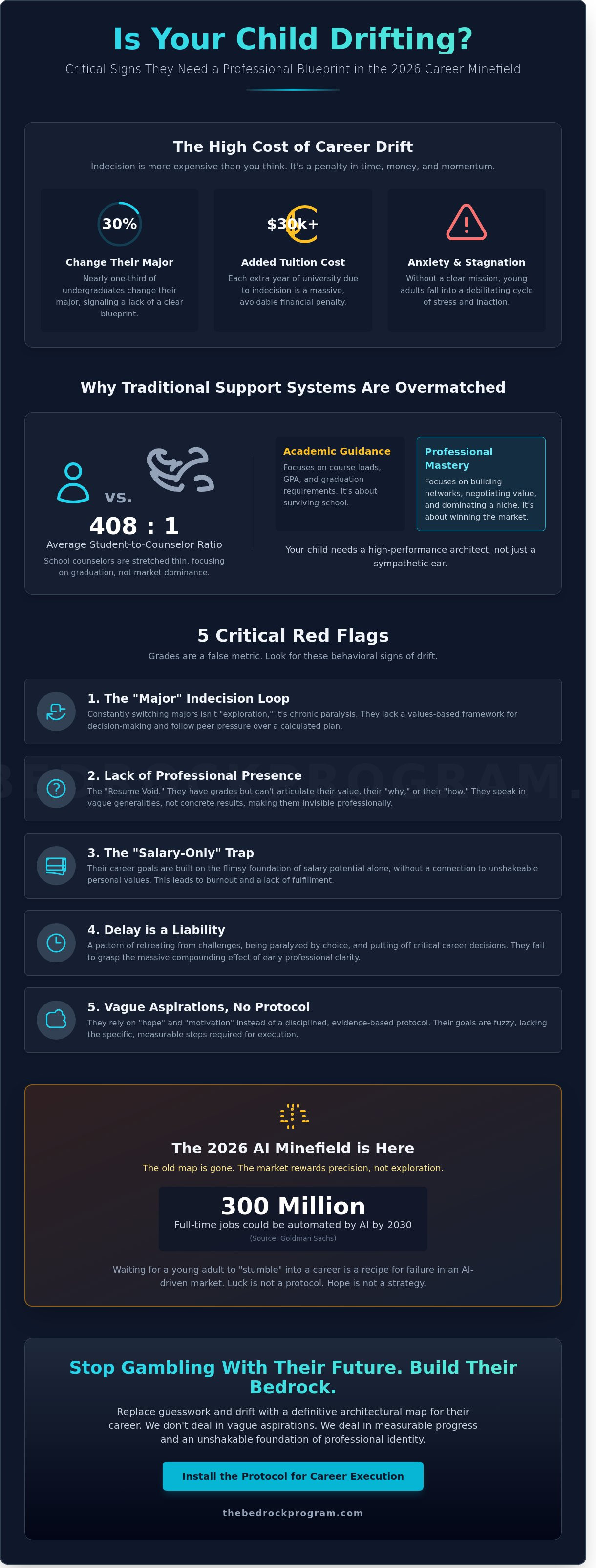
Potential is the most expensive resource a parent can waste. You see the talent, but without a protocol, it's just noise. Data from the National Center for Education Statistics shows that 30% of undergraduates change their major at least once, often at a massive financial and emotional cost. If your child is drifting aimlessly through high school or university, you are witnessing a failure to launch in real time. Recognizing the signs my child needs a career coach is the difference between building a bedrock foundation and watching the structure crumble before it even starts.
You want your child to be independent, driven, and disciplined. We agree that hope is not a strategy for professional mastery. You deserve the confidence that they are building a life based on core values, not luck. This article will identify the critical red flags that your child lacks a professional blueprint and teach you how to install the standards required for career execution. We are breaking down the protocol to eliminate guesswork and replace it with a definitive architectural map for their future in 2026. No more drifting. Just results.
Key Takeaways
Stop gambling with your child's future in a volatile AI-driven market where "figuring it out" is a failing strategy.
Identify the specific behavioral red flags and signs my child needs a career coach to install a professional bedrock.
Escape the "salary only" trap by building a blueprint where market demand meets unshakeable personal values.
Recognize the massive compounding effect of early professional clarity and why delay is a liability your child cannot afford.
Deploy an evidence-based protocol to select a coach who delivers raw results over "life coaching" fluff.
Table of Contents The 2026 Career Minefield: Why "Figuring It Out" Is Not a Strategy 5 Critical Signs Your Child Needs a Professional Blueprint Values-Based Coaching: The Antidote to the "Salary Only" Trap The Cost of Delay: Why Early Intervention Is a Competitive Advantage Executing the Blueprint: How to Choose the Right Coach
The 2026 Career Minefield: Why "Figuring It Out" Is Not a Strategy
The 2026 professional market is a meat grinder. It does not reward "exploration" or "finding yourself." It rewards precision. Goldman Sachs reports that AI could automate 300 million full-time jobs by 2030. Traditional career paths have evaporated. The old map is gone. If you are looking for signs my child needs a career coach, the chaos of the current economy is your first indicator. Waiting for a young adult to stumble into a career is a recipe for failure. Luck is not a protocol. Hope is not a strategy. Success in this environment requires a definitive blueprint and the discipline to execute it.
The High Cost of Career Drift
Indecision is expensive. Data shows that 33% of college students change their major at least once. This delay often tacks on an extra year of tuition. At an average cost of $30,000 per year for out-of-state public universities, that is a massive financial penalty for "figuring it out." The psychological toll is even heavier. Without a clear mission, young adults fall into a cycle of anxiety and stagnation. They become spectators in their own lives. Career drift is the gap between potential and execution. We eliminate that gap. We replace drift with a foundation of iron. We build the Bedrock. This is about establishing professional standards before the world forces them upon you.
Why School Counseling Isn’t Enough
High school and university offices are overmatched. The average student-to-counselor ratio in U.S. public schools is 408 to 1. These offices focus on graduation requirements, not market dominance. While historical career counseling provides a basic framework for interest testing, it lacks the high-intensity execution needed for 2026. Generic advice fails Gen Z because the market is hyper-specialized. Choosing a major is academic guidance; mastering a high-value skill set is professional mastery. Most counselors have never operated in the private sector trenches. They can't teach what they haven't lived. Your child doesn't need a sympathetic ear. They need a high-performance architect.
Academic Guidance: Managing course loads and GPA.
Professional Mastery: Building a network, negotiating value, and dominating a niche.
The Bedrock: An unshakable foundation of professional identity that survives market volatility.
If you see your child retreating from challenges or paralyzed by choice, these are clear signs my child needs a career coach who understands the Bedrock protocol. We don't deal in vague aspirations. We deal in measurable progress. Stop waiting for the world to hand your child a future. Build it.
5 Critical Signs Your Child Needs a Professional Blueprint
Grades are a false metric. A 4.0 GPA proves your child can follow academic instructions, but it doesn't prove they can execute in a high-stakes professional environment. Stop looking at the report card. Look at the behavioral standards. If your child lacks a system for decision-making, they are drifting. This drift is the first of many signs my child needs a career coach to build a real foundation.
Most parents fall for the Motivation Myth. They think their child needs a pep talk or a "discovery" phase. Wrong. Motivation is a feeling; it's volatile and unreliable. Your child doesn't need to "find their passion." They need a protocol. They need a system that dictates how they show up, how they speak, and how they plan. Without a blueprint, they are just guessing. In the 2026 economy, guesswork is a liability.
Sign 1: The "Major" Indecision Loop
Exploration is healthy for a twelve year old. It's a crisis for a university student. Data from the National Center for Education Statistics shows that 30% of students change their major at least once within three years. This isn't "finding yourself." It's chronic paralysis. High schoolers often pick paths based on what their social circle does. University students cycle through degrees because they lack a values-based framework. A professional blueprint replaces peer-pressure choices with calculated execution. It stops the loop.
Sign 2: Lack of Professional Language and Presence
If your child can't articulate their value proposition in sixty seconds, they are invisible. We see the "Resume Void" constantly. These are students with high grades but zero professional narrative. They have no "why" and no "how." They speak in vague generalities instead of concrete results. This lack of presence is a direct threat to their career mastery. You can find the specific standards for this in our Professional Development guide. Mastery requires more than just showing up; it requires a presence that commands respect.
Sign 3: High Anxiety Regarding the Future
Future-paralysis is a pandemic among Gen Z. A 2023 survey found that 70% of young adults experience significant stress regarding their career path. This isn't a mental health issue. It's a clarity issue. Anxiety lives in the gap between where they are and where they think they should be. When a child lacks a definitive map, they freeze. Clarity is the only antidote to this struggle. By identifying the signs my child needs a career coach, you are acknowledging that stress is a symptom of a missing structure. A clear protocol eliminates the unknown. It replaces fear with a series of actionable steps. No guesswork. Just results. If you want to see how we build these systems, explore the methodology at The Bedrock Program to see what a real foundation looks like.
Values-Based Coaching: The Antidote to the "Salary Only" Trap
The old career model is dead. High salaries no longer buy loyalty or sustained effort from the next generation. Gen Z is rejecting the prestige trap that fueled previous decades. They see through the hollow promise of a corporate title that demands the sacrifice of core principles. If your teenager shows total apathy toward traditional high-paying paths, these are clear signs my child needs a career coach who understands the 2026 market landscape.
Values-based coaching is the protocol for this new reality. It is not about vague self-discovery. It is a rigorous system that identifies the intersection of market demand and personal standards. We build on a foundation of truth. When a career aligns with an internal code, retention and success become inevitable. The alternative is the job scanning mentality. This is a weak cycle of chasing the next paycheck while the spirit erodes. It leads to total burnout before age 25. It is a failure of professional architecture.
Building the Professional Identity
We utilize the High-Performance Architect approach to self-discovery. This is not a personality test; it is a structural analysis. What you do must be driven by who you are. If the internal blueprint is flawed, the external career will collapse under the first sign of pressure. We demand total clarity before the first application is sent. Professional Bedrock is the alignment of skills, values, and execution.
Gen Z and the UN Sustainable Development Goals
Modern youth seek impact as much as income. They are not interested in being a cog in a machine that produces nothing of value. Data from the 2023 Deloitte Gen Z and Millennial Survey confirms that 44 percent of Gen Z have rejected employers based on personal ethics. These young professionals are looking at the 17 UN Sustainable Development Goals as a roadmap for a life of consequence. They want to solve problems like climate action or reduced inequalities while they build their wealth.
Impact is the new currency in the 2026 economy. The Bedrock Program integrates these global standards into a personal career roadmap. We do not just find a job; we align individual goals with global impact. This creates a career that is resilient to market shifts. If a young adult is struggling to find a "why" behind their work, these are signs my child needs a career coach to help them build a legacy. No guesswork. Just results.
The Cost of Delay: Why Early Intervention Is a Competitive Advantage
"They have plenty of time." This is the most dangerous phrase in a parent's vocabulary. It is a lie that breeds complacency. In the 2026 economy, time is a depleting asset. Waiting until senior year to think about a career is like waiting for the starting gun to buy your running shoes. You have already lost the race. The competition is already miles ahead, fueled by clarity and a proven blueprint.
Professional success follows the law of compounding interest. Early professional clarity does not just add value; it multiplies it. When a student identifies their trajectory early, every internship, every elective, and every conversation builds toward a singular goal. There is no wasted movement. No guesswork. Only execution. This early intervention transforms a resume from a list of tasks into a record of mastery. Recognizing the signs my child needs a career coach now prevents years of wandering later.
Career coaching is not a luxury expense for the elite. It is a strategic investment in a child’s foundation. It is the difference between a student who graduates with a degree and a student who graduates with a career. The cost of a four-year degree is too high to treat the outcome like a coin flip. You are building a professional bedrock. Do it right the first time.
Strategic Advantage in the Job Market
Coached students do not compete for entry-level roles. They dominate them. By the time they graduate, they have already established a protocol for high performance that their peers lack. They understand how to leverage 85 percent of the job market that never appears on a public board. This is the result of focused student engagement. They follow the same rigorous standards set by Student Engagement Programs for Universities in the UAE. They don't just show up. They lead. They don't just apply. They are recruited.
Eliminating the "Failure to Launch" Risk
The "boomerang generation" is a symptom of a weak foundation. Recent data indicates that 52 percent of young adults live with their parents. This is not a lack of talent. It is a failure of execution. Without a clear map, students drift back to the comfort of home. Career coaching installs the Bedrock Standards required for true independence. It forces ownership. It demands accountability. By identifying the signs my child needs a career coach today, you are ensuring they never have to look back. You are giving them the tools to build their own house, not just occupy yours.
Stop leaving your child's future to chance.
Executing the Blueprint: How to Choose the Right Coach
Stop looking for a cheerleader. Start looking for an architect. Most career coaches provide nothing but polished resumes and empty platitudes. In the high-stakes environment of 2026, those are useless. You need a program built on a bedrock of discipline and strategic execution. If you have identified the signs my child needs a career coach, your next move determines their trajectory for the next decade.
The market is flooded with "life coaches" who prioritize feelings over frameworks. Avoid them. Your child needs a high-performance mentor who understands the mechanics of the modern economy. Demand a professional who has operated at the executive level. Academic credentials look good on a wall, but real-world battle scars win in the boardroom. No guesswork. Just results.
The Bedrock Criteria for Selection
Use this protocol to evaluate any coaching program. If they fail one step, walk away.
Step 1: Verify the methodology. Is it values-based or just resume-fixing? A resume is a tool; values are the engine. Without a values-driven foundation, your child will drift. A true blueprint aligns their career with their core identity.
Step 2: Check for global standards. Seek coaches with executive-level mentorship experience. You want someone who has hired, fired, and led teams in the real world. They must understand the 2026 job market, where technical skill is the baseline and character is the differentiator.
Step 3: Demand measurable outcomes. Look for structured execution plans. A 22% increase in internship acquisition or a 30% improvement in professional networking efficacy are metrics. "Improved confidence" is a byproduct, not a goal.
Next Steps: From Drift to Mastery
Starting the conversation is the hardest part. Don't be soft. Be direct. Explain that the signs my child needs a career coach are indicators of untapped potential, not failure. Tell them the world is competitive. 2026 will not be kind to the unprepared. This isn't about fixing a problem; it's about building a powerhouse.
The coaching relationship requires tough love. High standards are the only path to growth. Your child doesn't need a friend; they need a strategist who demands total accountability. This is the difference between a job and a legacy. It's time to stop overthinking and start executing.
Success is not an accident. It is a construction project. Book a Career Clarity Workshop to start building your child’s blueprint today.
Secure the Professional Foundation
The 2026 job market is a minefield. Luck isn't a strategy. Hope isn't a protocol. If your child is drifting, they're falling behind a global cohort of high-performers. Recognizing the signs my child needs a career coach is the difference between a lifetime of mediocrity and a legacy of mastery. We replace the "figuring it out" mentality with a definitive architectural map for life.
The Bedrock Program is built on evidence-based frameworks aligned with the 17 UN Sustainable Development Goals. Founded by former global executive Audrey Hametner, our Dubai-headquartered operation delivers a global track record of elite results. We don't offer vague advice. We execute a blueprint based on high-performance standards and measurable progress. The cost of delay is a competitive disadvantage your child can't afford to carry into their future.
The path to elite performance starts with a single decision. Build the foundation now.
Frequently Asked Questions
Is career coaching only for students who are struggling in school?
No. Career coaching isn't a remedial protocol for the failing; it's a performance multiplier for the ambitious. Even students with a 4.0 GPA often lack a strategic blueprint for the 2026 labor market. Data from the 2024 National Association of Colleges and Employers shows that 53 percent of graduates are underemployed. We build the bedrock now so they don't become a statistic later. Mastery requires a plan, not just a report card.
What is the ideal age to start working with a career coach?
The optimal window to implement this protocol is age 15 or 16. By the sophomore year of high school, students must begin defining their professional standards to align with specific college track requirements. Waiting until senior year is a failure of execution. Starting at 15 allows for 24 months of intentional skill acquisition before the university application cycle begins. This is about building a foundation before the pressure mounts.
How is career coaching different from what high school counselors provide?
School counselors manage administrative logistics while career coaches execute a high-performance strategy. The average US high school counselor oversees 408 students according to 2023 ASCA data. They don't have the bandwidth for deep mastery. A coach provides a personalized blueprint for market dominance. We don't just check boxes for graduation. We build a professional architect ready for the 2026 economy. No guesswork. Just results.
Can a career coach help my child choose a university major?
Yes, we treat major selection as a high-stakes investment decision. Choosing a major without a career protocol is a recipe for debt and stagnation. We analyze market trends and individual aptitude to ensure the choice has a measurable ROI. If you see signs my child needs a career coach, it's usually because they lack a clear target. We provide the target and the trajectory. We turn uncertainty into a definitive map.
What if my child is resistant to the idea of a career coach?
Resistance usually stems from a lack of vision, not a lack of ability. We frame the program as a tool for autonomy rather than another parental demand. When a young man realizes he's building his own empire, his mindset shifts from passive to aggressive. We set the standards; he executes the plan. It's about taking ownership of his future bedrock. We move from "have to" to "want to" through results.
How long does a typical career coaching program take to show results?
Expect to see a shift in mindset within the first 90 days. A standard execution protocol typically runs for 6 months to establish permanent habits and professional clarity. This isn't a quick fix; it's an architectural overhaul of their future. By the 180-day mark, the student should have a completed blueprint for their career path and the discipline to follow it. Mastery takes time. Results require consistency.
Does career coaching help with finding internships and first jobs?
Finding elite opportunities is a core component of the execution phase. We teach the mechanics of networking and the science of high-impact resumes. According to 2025 workforce projections, 85 percent of roles are filled through professional connections rather than job boards. We don't wait for openings to appear. We train students to hunt for opportunities using a proven system. No luck involved. Just tactical execution.
How much should I expect to invest in a career coaching program in 2026?
Investment levels vary based on the intensity of the protocol and the duration of the engagement. Industry reports from the International Coaching Federation indicate that professional coaching rates reflect the specialized expertise required for high-level results. You're investing in a foundation that prevents the 100,000 dollar mistake of a wasted degree. Look for programs that prioritize measurable outcomes over vague sessions. Quality execution has a price, but mediocrity costs more.



Comments