

Is It Too Late to Change Your Career Path? The 2026 Pivot Protocol
Updated: Apr 16
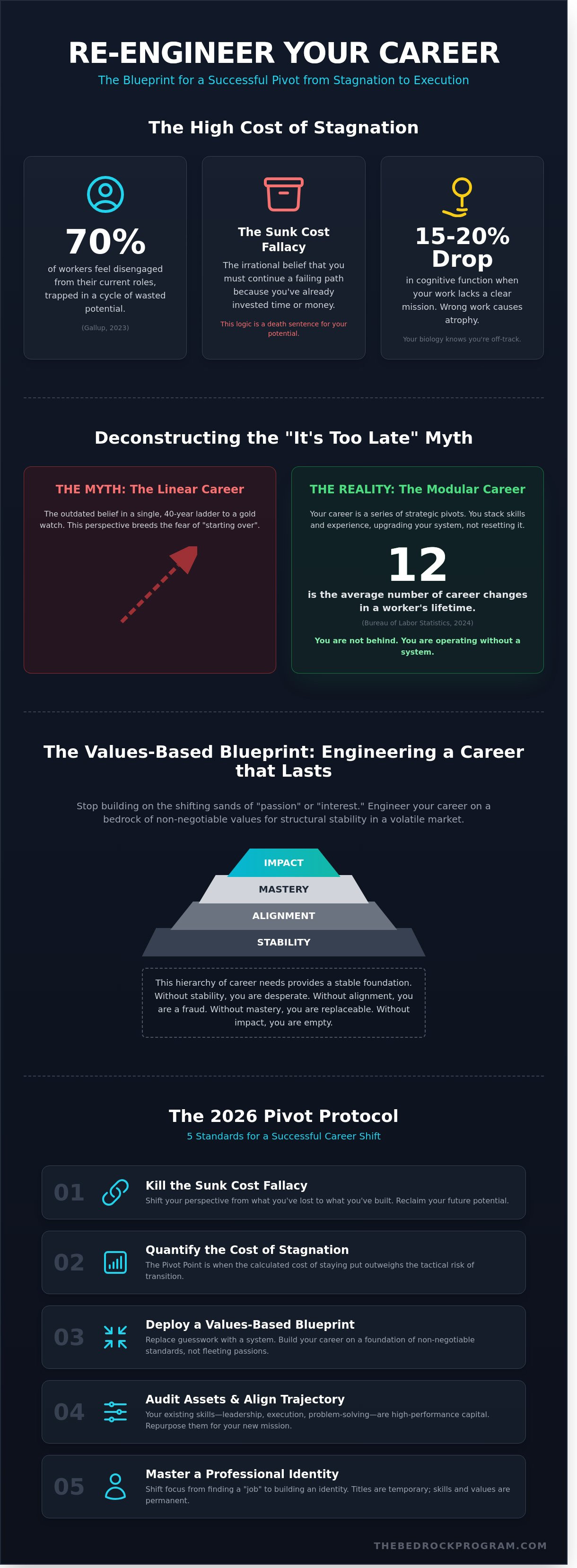
Your degree is a sunk cost, not a life sentence. Over 70% of workers feel disengaged from their current roles according to 2023 Gallup reports. You're likely staring at your screen right now, wondering, is it too late to change my career path after a decade of specialized labor. You feel the weight of those years. You believe starting over means starting from zero. You're wrong. According to 2024 Bureau of Labor Statistics data, the average worker changes careers 12 times in their lifetime. You aren't behind; you're just operating without a system.
The 2026 Pivot Protocol is your architectural map for professional reconstruction. It stops the bleeding of wasted potential. This isn't about "finding yourself." It's about execution. You need a foundation that handles the weight of your ambitions. I'll provide a definitive answer on your transition's feasibility and hand you the Blueprint to pivot without losing your hard-earned momentum. We are moving from guesswork to a structured system of standards. No more asking for permission. No more stalling. We begin the execution phase now.
Key Takeaways
Kill the sunk cost fallacy that keeps you anchored to a dead-end career and reclaim your future potential.
Stop asking is it too late to change my career path and start quantifying the high cost of your current stagnation.
Replace the guesswork of traditional career tests with a Values-Based Blueprint designed for long-term structural stability.
Deploy the Pivot Protocol to audit your existing assets and align your trajectory with your non-negotiable standards.
Shift your focus from finding a job to mastering a professional identity built on a foundation of elite execution.
Table of Contents The Sunk Cost Fallacy: Why You Feel 'Behind' (And Why You Are Not) The Values-Based Blueprint: Engineering a Career That Actually Works Auditing the Risk: The Real Cost of Career Stagnation vs. Execution The Pivot Protocol: 5 Standards for a Successful Career Shift Building Your Bedrock: How to Master Your Professional Identity
The Sunk Cost Fallacy: Why You Feel 'Behind' (And Why You Are Not)
Stop looking at the clock. You think you've wasted a decade. You haven't. You've been building a foundation. Most men stay in dead-end roles because they spent $50,000 on a specific degree or five years in a cubicle. This is a psychological trap. It's called the sunk cost fallacy. It's the irrational belief that you must continue an investment simply because you've already spent resources on it. In the 2026 economy, this logic is a death sentence for your potential.
The idea of starting over is a myth. You aren't a 22-year-old rookie. You are an operator with high-performance capital. Your ability to lead, execute, and solve problems doesn't vanish when you change industries. You're not resetting the clock; you're upgrading the software. Mastery has no expiration date. You don't need a new life. You need a better blueprint. If you find yourself asking is it too late to change my career path, you are already operating from a position of weakness. Shift your perspective from what you've lost to what you've built.
Deconstructing the 'Late' Myth
Social media creates a distorted reality. Gen Z professionals often feel old at 24 because they haven't hit a six-figure milestone seen on a TikTok feed. This is a failure of perspective. Linear careers are dead. The 2026 economy demands modular careers. You build skills in blocks. You stack them. Professional development isn't about climbing one ladder for forty years. It's about maintaining agility through constant execution. You don't ask is it too late to change my career path when you realize that your career is a series of strategic pivots, not a straight line to a gold watch. Standards don't have a deadline.
The Biology of Professional Burnout
Staying in a misaligned career isn't grit. It's systemic performance failure. Your biology knows when you're off-track. Cortisol levels rise. Cognitive function can drop by 15 to 20 percent when your work lacks a clear mission. There's a massive difference between hard work and wrong work. Hard work builds muscle; wrong work causes atrophy. You cannot optimize a system that is fundamentally broken. Recognition of this friction is the first step toward mastery.
The Pivot Point is the precise moment when the calculated cost of remaining in a stagnant position outweighs the tactical risk of executing a career transition.
The Values-Based Blueprint: Engineering a Career That Actually Works
Stop asking is it too late to change my career path and start inspecting your foundation. Most men build their professional lives on the shifting sands of "interest" or "passion." This is a structural failure. Interests are seasonal. Passion is a feeling; feelings are unreliable fuel for a thirty-year engine. You need Bedrock. You need a career built on enduring core values that do not crack when the market gets volatile. No guesswork. Just results.
Traditional career tests fail because they measure what you like to do on a Saturday afternoon. They don't measure what you are willing to suffer for. According to the U.S. Bureau of Labor Statistics, the median employee tenure for men is currently 4.3 years. Movement is the new constant. To survive this, you must build a hierarchy of career needs: stability, alignment, mastery, and impact. Without stability, you are desperate. Without alignment, you are a fraud. Without mastery, you are replaceable. Without impact, you are empty.
Mapping Your Core Values
Extraction is the first step. You must strip away the noise of parental expectations and societal "shoulds" to find your true drivers. This isn't about what looks good on a resume; it's about your Non-Negotiable Standards. If you value autonomy but work in a micro-managed cubicle, you will burn out. It is a mathematical certainty. For a tactical deep dive into this process, use the Values-Based Career Guidance: Find Your Path pillar. Remember that passion is a dangerous metric. It blinds you to the reality of the grind. Mastery is the goal. Passion is just a byproduct of being elite at what you do.
The Modern Workplace Reality
The 2026 job market does not reward the generalist. It rewards the specialist with a diverse foundation. High-performance architects are now integrating their personal mission with global challenges, such as the UN Sustainable Development Goals. This isn't "wellness" talk. It is about solving specific, high-value problems that the market is desperate to fix. Your professional identity cannot be tied to a specific job title. Titles are temporary; skills and values are permanent. If you are questioning if is it too late to change my career path, remember that your identity is the architect, not the building. You can always draft a new set of plans. If you are ready to stop guessing, you can audit your current standards to see where the cracks are forming.
Auditing the Risk: The Real Cost of Career Stagnation vs. Execution
Staying in a "safe" job that drains your soul isn't low risk. It's a calculated slow death. Most men ask, "is it too late to change my career path" because they fear the unknown. They should fear the known. A 2023 Gallup report found that 60% of employees are emotionally detached at work. This isn't just a mood. It's a performance leak. Staying put costs you more than a paycheck. It costs you your health, your edge, and your future market value.
Execution requires a side-by-side audit. On one side, you have stagnation. This leads to a 15% decrease in individual productivity and eventual obsolescence as your industry-specific skills rot. On the other side, you have the strategic pivot. This involves a short-term dip in seniority for a massive lift in your long-term performance ceiling. You aren't starting from zero. You are porting over years of leadership, problem-solving, and grit. That's your bedrock. You are rebuilding the structure, not the foundation.
The invisible costs are the most dangerous. A 2022 study by the American Psychological Association found that 79% of employees experience work-related stress that leads to physical fatigue and cognitive decline. That is a direct tax on your longevity and your family's future. The ROI of a career change isn't just about the money. It's about the ceiling. If your current path caps at $100,000, but the new path starts at $80,000 with a $250,000 ceiling, the initial dip is irrelevant. It's a strategic investment in your future capacity.
The Financial Reality of the Pivot
Psychological Stability During Transition
Confidence is a luxury. Discipline is a requirement. When you become the "new" person in the room, your ego will take a hit. Ignore it. Focus on the work. Maintain a high-performance mindset by treating every task like a mission. Speed up the process by using professional development to close skill gaps rapidly. Mastery takes time, but intensity compresses that timeline. You don't need to feel ready. You just need to follow the protocol.
The Pivot Protocol: 5 Standards for a Successful Career Shift
Stop asking is it too late to change my career path. Doubt is a liability. You need a system. The Pivot Protocol is a five step blueprint designed to strip away the noise and focus on objective results. This is not about finding yourself. It is about rebuilding your professional architecture for maximum output.
Step 1: The Foundation Audit. Identify every asset you currently own. This includes technical skills, soft skills, and your professional reputation.
Step 2: The Value-Alignment Check. Does the new path meet your non-negotiable standards? If it doesn't provide the autonomy or the ceiling you require, discard it.
Step 3: The Skill Acquisition Phase. Engage in targeted, high-intensity learning. Focus only on the tools that move the needle.
Step 4: The Network Deployment. Build social capital. You don't need a thousand contacts. You need five high-leverage advocates in your target industry.
Step 5: The Execution Phase. Launch. Iterate. Refine. Do not wait for the perfect moment. It doesn't exist.
Standard 1: Inventory Your Transferable Capital
Your previous experience is not wasted time. It is accumulated fuel. Soft skills are the Bedrock of every industry. Leadership, discipline, and emotional intelligence don't expire when you change zip codes or job titles. You must reframe your narrative. A project manager in construction is actually an expert in resource synchronization and risk mitigation. These are the same skills required in tech or finance. Transferable skills are the universal currency of the modern workforce, regardless of industry. According to the 2023 LinkedIn Workplace Learning Report, 89 percent of professionals agree that building these core skills is the primary driver of career longevity. Stop looking at what you lack. Start leveraging what you already own.
Standard 2: Strategic Skill Mastery
Speed is the objective. You don't have four years to sit in a lecture hall. You must identify high-leverage skills that provide the fastest entry into your new field. Use the 80/20 rule. In almost every industry, 20 percent of the skills produce 80 percent of the results. Master the vital few. Ignore the trivial many. This is about surgical precision. Avoid the permanent student trap. This is a common form of procrastination where you hide behind certifications and degrees to avoid the discomfort of execution. Learn the minimum viable skill set required to produce value, then learn the rest through direct action. The Bureau of Labor Statistics reported in 2023 that the average worker changes jobs 12.4 times. You aren't an outlier. You are simply the one with a plan.
If you are ready to stop making excuses and start building a life on your terms, it is time to upgrade your standards.
Building Your Bedrock: How to Master Your Professional Identity
Stop chasing a paycheck. Build a professional identity instead. Most men fail because they build on sand. They seek external validation through titles and salaries. This is a weak foundation. It collapses when the market shifts or the industry evolves. You don't need a new job. You need a professional identity built on an unshakable core.
The Bedrock Program focuses on career clarity through structured youth engagement and raw data. We strip away the noise of what you "should" do. We replace it with what you are engineered to do. Many men ask, is it too late to change my career path? They focus on the clock. They should focus on the system. Timing is a distraction. Execution is the only metric that matters. Stop overthinking the calendar. Start building the system.
The Role of Coaching in Career Transformation
High-performers never pivot alone. Elite athletes have coaches. Tier-one operators have teams. Why are you trying to rebuild your life in a vacuum? Whether it is the physical discipline found in a קבוצת טריאתלון ברחובות or the mental rigor of a career shift, coaching provides the necessary structure. Advice is cheap. Most people give it without skin in the game. Evidence-based coaching frameworks are different. They rely on protocols, not opinions. The Bedrock Program bridges the gap between your current stagnation and your future mastery. We provide the blueprint. You provide the effort. No guesswork. Just results.
Next Steps: Your First 30 Days
Stop overthinking. Start executing. Your first month requires a strict protocol to ensure the new path sticks. Establish these standards immediately:
Audit your assets: List every skill you possess. Eliminate the ones that don't serve the new blueprint.
Define the target: Identify three high-leverage roles that align with your data-driven profile.
Daily Standards: Set non-negotiable windows for skill acquisition. Two hours of deep work. Every day. Zero excuses.
Systems beat luck every time. If you are still wondering if is it too late to change my career path, you are wasting valuable energy. The clock is ticking. Establish your foundation now. Take the Career Test to begin your data-driven transformation today.
Master the Pivot: Execution Over Hesitation
Stagnation is a silent killer of potential.
The 2026 market doesn't reward those who wait for permission.
You've learned that the sunk cost fallacy is a mental trap, not a structural reality.
Real growth requires a blueprint that prioritizes values over comfort.
Stop asking is it too late to change my career path; instead, ask if you're prepared to execute the standards required for a shift.
This isn't about luck. It's about a scientific approach to professional identity.
No fluff. Just execution.
You need a foundation that won't crack under pressure.
Global executive Audrey Hametner founded a system built on evidence-based frameworks aligned with the UN Sustainable Development Goals.
This same values-based coaching is currently utilized by top UAE universities to develop elite talent.
Stop overthinking and start building.
Build your professional foundation with The Bedrock Program today.
Your future isn't written in the past. You have the tools. Now, go forge it.
Frequently Asked Questions
Is 30 too late to change my career path?
No, 30 is the prime age for a strategic pivot. Data from the Bureau of Labor Statistics shows the average worker holds 12.4 jobs before age 55. If you are asking is it too late to change my career path at 30, you are overthinking. You have 35 years of high-performance output ahead of you. Build your new blueprint now. Mastery takes time, but your foundation is already solid.
How do I change career paths with no experience?
Leverage your transferable skills and build a new network immediately. LinkedIn data indicates that 70 percent of professionals land jobs through networking rather than standard applications. Don't focus on what you lack. Focus on your execution. Identify three core standards from your previous role that apply to the new industry. Execute a 90-day skill acquisition protocol to bridge the gap. Results speak louder than a degree.
What are the best career paths to switch into in 2026?
Target sectors with projected explosive growth, specifically renewable energy and specialized healthcare technology. The Bureau of Labor Statistics projects a 45 percent growth rate for wind turbine technicians through 2032. Data science and cybersecurity also show 32 percent growth projections. These aren't just jobs. They are high-performance sectors. Choose a field where the demand exceeds the supply. That's the blueprint for long-term stability.
Will I have to take a pay cut if I change careers?
A pay cut is not a requirement if you leverage your existing expertise correctly. An Indeed survey from 2023 found that 49 percent of career changers actually earned more after their transition. You might take a 10 percent lateral dip initially to secure a higher ceiling. View it as an investment in your foundation. Short-term sacrifice leads to long-term mastery. Don't let a temporary number stop your progress.
Can I change my career path while working full-time?
Yes, you change your trajectory by owning your 5 to 9 window. Research shows 60 percent of successful transitions happen while the individual maintains a full-time income. It requires a strict protocol. Dedicate two hours every night to skill acquisition. This isn't about balance. It's about obsession. If you are wondering is it too late to change my career path, the answer lies in your daily schedule.
How do I know if I'm ready for a career change or just having a bad week?
Track your metrics over a 90-day period to separate emotion from systemic failure. Clinical data suggests that standard burnout lasts at least 12 weeks before it indicates a need for a total pivot. If your performance remains high but your fulfillment is zero after three months, the problem is the path. Don't quit because of a bad Tuesday. Quit because the current blueprint no longer fits your standards.
What is the fastest way to gain new skills for a pivot?
Immersive bootcamps and industry-recognized certifications are the fastest routes to a pivot. Coding bootcamps, for example, typically run for 12 to 15 weeks and show a 71 percent placement rate. This is high-intensity training for your brain. Forget four-year degrees. They are too slow for the modern economy. Find a 90-day protocol that offers a direct certification. Speed is an asset. Execution is everything.
How do I explain a career change on my resume?
Use a functional resume format that highlights your core competencies over your chronological history. Recruiters spend an average of 7.4 seconds scanning a resume. Your summary must be a punchy, high-impact statement of your value proposition. Map your previous wins to the new role's requirements. Show them you have the foundation to succeed anywhere. Be direct. Eliminate the fluff. Let your results drive the narrative.



Comments