

Fear of Choosing the Wrong Major: The Protocol for Absolute Certainty
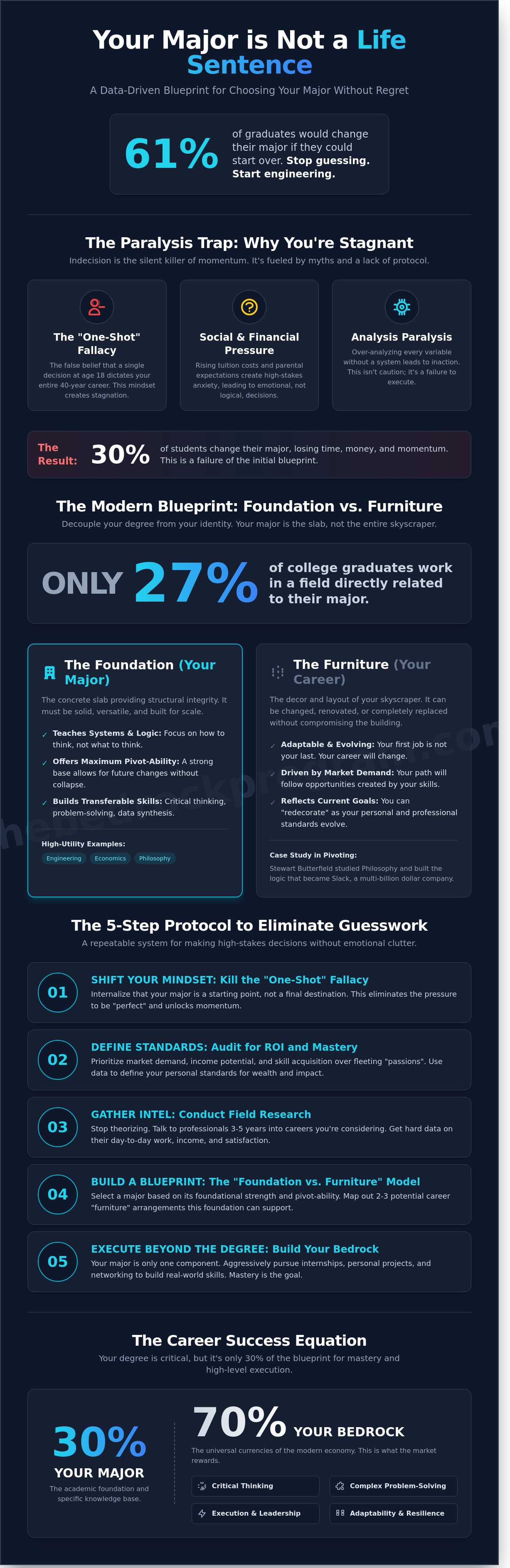
Your degree is not a life sentence, yet a 2019 BestColleges survey found that 61% of graduates would change their major if they could start over. You're likely paralyzed by the fear of choosing the wrong major because you've been told this single decision dictates your entire 40 year career arc. You feel the pressure of rising tuition and the silent weight of parental expectations. It's time to stop guessing. This isn't about "finding your passion." It's about engineering a life.
I am giving you a protocol for absolute certainty. You will learn to build a career foundation based on data, values, and execution. No more overthinking. No more wasted years. We are going to establish the standards that dictate your future wealth and impact. This article provides a repeatable system for making high stakes decisions without the emotional clutter. It's time to stop the paralysis and start building your legacy. This is the blueprint for a man who demands mastery over his own direction. No guesswork. Just results.
Key Takeaways
Stop the "one-shot" fallacy. Kill the indecision stalling your momentum and learn why your major is the slab, not the entire structure.
Eliminate the fear of choosing the wrong major by decoupling your degree from your identity. Use the "Foundation vs. Furniture" blueprint to build for scale.
Audit your path for ROI and mastery. Prioritize market demand over fleeting passions to ensure your degree delivers a measurable return.
Execute the 5-step protocol to eliminate guesswork. Use the Inventory Audit and field research to gather hard data before you commit.
Build your bedrock beyond the degree. Mastery is the goal; your major is only 30% of the career success equation.
Table of Contents Why the Fear of Choosing the Wrong Major Is Paralyzing You Decoupling the Major from the Career: The Modern Blueprint Standards Over Passions: How to Audit Your Potential Path The 5-Step Execution Plan to Choose Your Major Without Regret Building Your Bedrock: Beyond the Degree
Why the Fear of Choosing the Wrong Major Is Paralyzing You
Indecision is a silent killer of momentum. Most men treat their degree choice like a terminal diagnosis. They freeze because they believe in the One-Shot Fallacy. This is the false belief that a single decision at age 18 dictates your entire trajectory for the next 40 years. It's a lie. This mindset creates a state of Analysis paralysis where you over-analyze every variable until you're unable to move. You aren't being careful; you're being stagnant.
The fear of choosing the wrong major stems from a lack of a decision-making protocol. Without a system, you're vulnerable to social noise. You listen to parents, peers, and outdated advisors instead of your internal signal. This leads to wasted semesters. National Center for Education Statistics (NCES) data from 2017 shows that about 30% of undergraduates change their major at least once within three years. That isn't "exploration." It's a failure of the initial blueprint. Every switched major is a lost tactical advantage. It's time to stop guessing and start executing.
The Myth of the 'Perfect' Major
Perfection is a recipe for chronic dissatisfaction. If you search for a major that provides 100% fulfillment, you'll never find it. Apply the 80/20 rule to your academic career. Expect 80% of your curriculum to be high-value training and 20% to be necessary grind. You won't love every class. That's a standard you must accept. The modern "passion" narrative is a trap. It increases student anxiety by suggesting that if you don't feel "inspired" every Monday morning, you're in the wrong field. Discipline beats passion. Systems beat feelings.
The Financial and Psychological Stakes
The cost of indecision is measurable. Students who change majors often take an average of 4.8 years to graduate according to NCES reports. This delay costs thousands in extra tuition and lost wages. Beyond the money, you face the psychological "sunk cost" trap. You stay in a misaligned major because you've already "invested" two years. This is a foundational error. A "wrong" major is often just a misaligned foundation. If the bedrock is cracked, you don't keep building; you pivot based on data, not emotion. You need a protocol that identifies these misalignments before they become financial liabilities. Stop letting the fear of choosing the wrong major dictate your timeline. Establish your standards and execute the plan.
Decoupling the Major from the Career: The Modern Blueprint
Your major is not your destiny. It is a data point. Data from the Federal Reserve Bank of New York reveals that only 27 percent of college graduates work in a career field directly related to their degree. Most men are paralyzed by the fear of choosing the wrong major because they believe a diploma is a life sentence. It is not. It is a foundation. Stop viewing your education as a narrow tunnel. View it as a launchpad.
Think of your degree as the concrete slab of a skyscraper. It provides the structural integrity. Your specific job title is the furniture. You can swap out the decor or renovate the interior without compromising the building. High-utility majors like Engineering, Economics, or Philosophy offer maximum pivot-ability. These disciplines teach systems and logic rather than just static facts. This is the Bedrock philosophy. Build skills that the market cannot ignore. The title on the diploma matters less than your capacity for high-level execution.
Academic research on college major anxiety highlights how students fixate on the immediate choice rather than long-term adaptability. Eliminating the fear of choosing the wrong major requires a shift in perspective. You must look past the four-year horizon and focus on the blueprint of your entire career. Standards matter more than subjects.
The Transferable Skills Protocol
By the year 2026, the global workplace will prize critical thinking and complex problem-solving above all else. These are the universal currencies of the modern economy. Employers do not care what you memorized for a midterm in 2022. They care how you think. They want to see your ability to synthesize data and lead under pressure. You must map your academic path to professional development standards that prioritize high-level output. Master the logic. The industry opportunities will follow naturally.
Case Studies in Career Pivoting
Look at the results of those who prioritize mastery over labels. Stewart Butterfield studied Philosophy and became the CEO of Slack. He used formal logic to build a billion-dollar communication empire. There are Biology students who now lead global logistics firms because they mastered systems thinking and applied it to complex supply chains. Audrey Hametner, a global executive with decades of experience, hires for Bedrock traits. She looks for discipline, accountability, and the ability to solve problems. She does not hunt for a specific major. She looks for a man who has built a solid foundation. If you want to stop feeling lost, you need a proven system for career mastery that focuses on results over theory.
Standards Over Passions: How to Audit Your Potential Path
Stop asking what you love. Passion is a liability; it fluctuates based on your mood. Instead, ask what you can master. Mastery creates a competitive advantage. The fear of choosing the wrong major disappears when you treat your degree like a capital investment rather than a hobby. You are building a professional bedrock. This requires a cold, calculated audit of every potential path before you commit four years of your life.
The ROI Audit is your first filter. Evaluate the market demand. If the degree does not offer a clear path to high-level execution and financial stability, it is fluff. Cut it. A major must provide a technical edge that is difficult to replicate. No guesswork. Just results.
The Market Demand Reality Check
Data drives decisions. The Bureau of Labor Statistics projects a 15 percent growth in computer and information technology occupations through 2031. This is much faster than the average for all occupations. You must look at 10-year projections to ensure your chosen field isn't shrinking. Safe majors are a myth in an AI-driven economy. Routine cognitive tasks are being automated at an aggressive pace. A 2023 report from Goldman Sachs suggests that AI could automate 300 million full-time jobs globally. To survive, your major must prioritize high-level problem solving or specialized technical literacy.
Projected Growth: Focus on sectors with a minimum 10 percent decade-over-decade expansion.
AI Resistance: Choose fields requiring complex human judgment or physical dexterity.
Technical Foundation: Every modern discipline now requires data literacy or coding proficiency.
Aligning Major with Personal Values
A major is a tool to build a lifestyle. It is not an identity. You must define your non-negotiables: salary floors, geographic flexibility, and level of autonomy. If you value location independence, do not choose a major that requires you to be in a specific laboratory or corporate headquarters. This is where values-based career guidance for students becomes the ultimate filter. It simplifies the choice by removing emotional noise and focusing on the architectural map of your life.
Apply the Day-in-the-Life test. Don't look at the textbook theory. Look at the actual work. Research the 8:00 AM to 6:00 PM reality of professionals in that field. If the daily grind violates your standards, the major is a failure. You are looking for a path that supports your long-term Blueprint. High performance requires alignment between your daily execution and your ultimate goals. Eliminate the fluff. Choose the path that demands mastery and rewards it with the lifestyle you command.
The 5-Step Execution Plan to Choose Your Major Without Regret
Indecision is a parasite. It drains your energy and stalls your progress. To kill the fear of choosing the wrong major, you need a tactical blueprint, not a "gut feeling." Use this five-step protocol to build your academic foundation.
Step 1: The Inventory Audit. Stop chasing "passion." Passion is fickle. Catalog your objective strengths. Identify where you possess a competitive edge. If you score in the top 10% on quantitative reasoning but hate calculus, you still have a data-driven advantage. Build on capacity, not just "likes."
Step 2: The Market Research Phase. Feelings are not facts. Schedule 15-minute interviews with three professionals currently working in your target field. Ask about their daily frustrations and 2024 salary benchmarks. Data from the Bureau of Labor Statistics shows that 27% of college grads work in a field unrelated to their major. Real-world intel prevents you from becoming a statistic.
Step 3: The 'Core-4' Filter. Run your top choice through four Bedrock standards: Market Demand, Skill Alignment, Scalability, and Grit. If the major doesn't hit at least three, discard it immediately. No exceptions.
Step 4: The 2-Year Pivot Window. Set a hard re-evaluation date exactly 24 months from today. This deadline reduces the fear of choosing the wrong major by providing a structured escape hatch. You aren't deciding for the next 40 years; you're deciding for the next 730 days.
Step 5: Final Committal. Once the choice is made, burn the boats. Execute with 100% focus. Total immersion is the only way to achieve mastery.
Phase 1: Internal and External Discovery
Career assessments are data points, not destiny. Use them to identify patterns in your behavior, but don't let a software algorithm dictate your life. When you speak to current students, ignore the campus tours. Ask them about the "3:00 AM reality." What is the workload like during finals? How many students dropped out of the program last semester? If you have a "maybe" pile of five majors, cut it to two by Friday. Efficiency requires ruthlessness.
Phase 2: The Decision Framework
Write your 'Major Manifesto.' This is a one-page document stating exactly why you chose this path and what your specific ROI goals are. Define what success looks like in 48 months. Do you want a $75,000 starting salary or a pathway to a specific graduate program? Set the standard now so you can measure it later. Remember, a "done" decision is superior to a "perfect" one that never happens. Perfectionism is just procrastination in a suit. Stop overthinking and start building.
Ready to stop guessing and start leading? It is time to master your life's blueprint and execute with precision.
Building Your Bedrock: Beyond the Degree
Your major is not your destiny. It is a tool. Data from the Federal Reserve Bank of New York in 2023 shows that only 27% of college graduates work in a field directly related to their major. The degree accounts for roughly 30% of your career success equation. The remaining 70% is built on execution, networking, and self-mastery. If you are paralyzed by the fear of choosing the wrong major, you are overvaluing the label and undervaluing the man.
The Extra-Curricular Blueprint is where the real war is won. According to 2022 data from the National Association of Colleges and Employers (NACE), 91% of employers prefer candidates with relevant work experience. You don't find this experience in a textbook. You find it through high-stakes internships and aggressive networking. University is not a four-year waiting room. It is a training ground to build an unshakable foundation.
Stop thinking like a student. Students wait for instructions. High-performance professionals create their own. The transition requires a total shift in standards. You must replace the "pass/fail" mentality with a "win/loss" reality. Every hour spent on campus is an investment in your personal infrastructure. Build the habits now. Mastery is a choice.
The Bedrock Program Advantage
Our coaching protocol bridges the gap between academic theory and professional execution. We eliminate the fear of choosing the wrong major by focusing on universal performance standards. Mentorship is the antidote to anxiety. We provide the tactical guidance needed to navigate corporate politics and high-pressure environments. You will build a network that transcends your degree title. This is about becoming a high-value asset in any industry.
Direct mentorship from industry leaders.
Systems for elite time management and discipline.
A network of high-performers who demand excellence.
Your Next Move
Stop scanning job boards like a victim. Start building a career like an architect. A "wrong" major is only a failure if you lack a secondary plan for mastery. If you have the right systems, the title on your diploma becomes secondary to the results you produce. You need a blueprint. You need standards. You need a foundation that cannot be shaken by market shifts or academic indecision.
Execution starts today. Secure your professional future with The Bedrock Program for Students.
Execute Your Protocol for Mastery
Indecision is a luxury you can't afford. The fear of choosing the wrong major is a symptom of a weak foundation. Stop relying on fleeting passions. Apply the 5-step execution plan to audit your path against high-performance standards. Decouple your degree from your identity. Your major is a tactical tool, not a life sentence. You must build a bedrock that survives market shifts and professional pivots.
Success isn't found in luck. It's engineered through precise systems. The Bedrock Program utilizes evidence-based frameworks aligned with the 17 UN Sustainable Development Goals to ensure your trajectory has global impact. Led by former global executive Audrey Hametner, this protocol focuses on high-performance results rather than generic advice. It eliminates the noise of the modern world. It demands total accountability. No guesswork. Just mastery.
Stop overthinking. Start building an unshakable future with a definitive architectural map for your life.
The world rewards the decisive. Take command of your path today.
Frequently Asked Questions
Is it really okay to change my major after freshman year?
Changing your major is a tactical pivot that 30% of undergraduates execute at least once according to the National Center for Education Statistics. It is better to correct your course early than to build a career on a weak foundation. You must act decisively to minimize credit loss. Ensure your new path meets the standards of your long term career blueprint before making the switch.
How much does my college major actually affect my future salary?
Your major is the primary driver of your lifetime earning potential. Data from Georgetown University’s Center on Education and the Workforce shows a $3.4 million gap in median lifetime earnings between the highest and lowest paying majors. Don't let the fear of choosing the wrong major paralyze you. Use these metrics to select a major that functions as a high yield investment.
What are the safest majors for the 2026 job market?
Healthcare and data science are the highest ground sectors for the 2026 economy. The Bureau of Labor Statistics projects a 45% growth rate for nurse practitioners and a 35% growth rate for data scientists through 2032. These fields provide an unshakable foundation for professional mastery. Engineering and cybersecurity also remain elite protocols for long term stability and high performance execution.
How do I tell my parents I want to change my major?
Present your parents with a data backed blueprint rather than an emotional plea. Show them the specific ROI of the new path, such as a 25% higher starting salary or a 90% job placement rate in that industry. Lead with facts and a clear execution plan. When you demonstrate total accountability and a structured vision, you eliminate their uncertainty and establish your authority.
Can I get a high-paying job with a liberal arts degree?
You can secure a high salary with a liberal arts degree if you integrate a technical protocol into your education. A 2023 Burning Glass Institute report indicates that liberal arts graduates who master data analysis or technical writing earn $15,000 more annually than those without these skills. The degree provides the frame, but you must build the high performance engine through specialized certifications and discipline.
What should I do if I have no idea what major to choose?
Stop waiting for inspiration and start an elimination protocol based on market demand. Analyze the top 10 highest growth industries identified by the Bureau of Labor Statistics and filter them by your strongest aptitudes. If you're trapped in the fear of choosing the wrong major, select the most difficult, high ROI path you can sustain. Movement creates clarity while indecision only breeds weakness.
Does the prestige of the university matter more than the major itself?
Your specific major dictates your salary floor more than the university's brand name. Research from the HEA Group shows that an engineering degree from a mid tier state school frequently outperforms a humanities degree from an Ivy League institution in terms of ROI. Prestige is often a vanity metric. Focus on mastering a high value skill set that meets the rigorous standards of the modern economy.


Comments