

Career Test: Stop Guessing and Start Building Your Professional Blueprint
Your gut is lying to you. Relying on "passion" to navigate your professional life is a strategy for mediocrity. Gallup's 2023 State of the Global Workplace report states that 85% of workers are not engaged at work. These men are drifting because they lack a structural foundation. You know the weight of decision paralysis. You see the endless options and fear choosing a path that leads to total burnout. It's time to stop guessing and use a data-driven career test to find your footing.
We agree that the modern "follow your heart" advice is a recipe for failure. You are tired of the noise and the uncertainty. You need a system that works. This is about identifying your non-negotiable values and building a professional blueprint that stands on bedrock. No more drifting. No more hesitation. Just results.
You'll learn how to leverage high-performance diagnostics to establish a clear professional identity and a data-backed starting point. This article outlines the exact protocol to gain total confidence in your next move and master your career path with surgical precision.
Key Takeaways
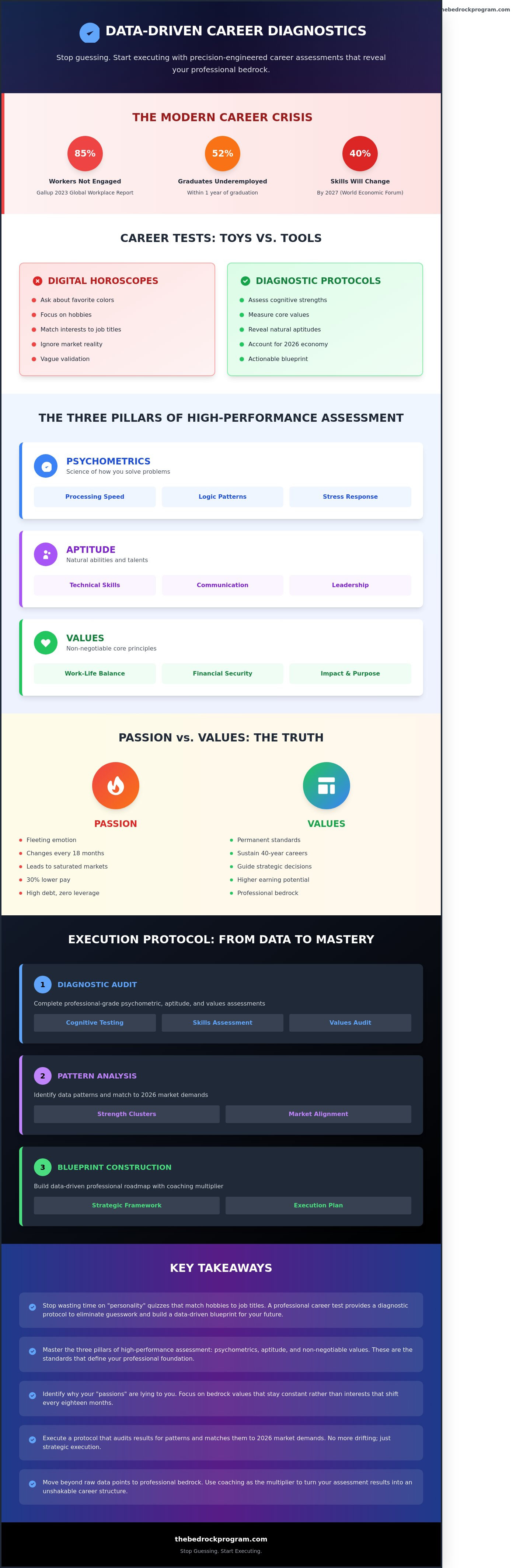
Stop wasting time on "personality" quizzes that match hobbies to job titles. A professional career test provides a diagnostic protocol to eliminate guesswork and build a data-driven blueprint for your future.
Master the three pillars of high-performance assessment: psychometrics, aptitude, and non-negotiable values. These are the standards that define your professional foundation.
Identify why your "passions" are lying to you. Focus on bedrock values that stay constant rather than interests that shift every eighteen months.
Execute a protocol that audits results for patterns and matches them to 2026 market demands. No more drifting; just strategic execution.
Move beyond raw data points to professional bedrock. Use coaching as the multiplier to turn your assessment results into an unshakable career structure.
Table of Contents Why Most Career Tests Are a Waste of Time in 2026 The Anatomy of a High-Performance Career Assessment Interests vs. Values: Why Your "Passions" Are Lying to You Protocol for Execution: Turning Test Data into Career Mastery From Data Point to Professional Bedrock: The Next Phase
Why Most Career Tests Are a Waste of Time in 2026
Most career tests are a complete waste of time. They function like digital horoscopes, offering vague validation instead of an actionable blueprint. If a quiz asks about your favorite color or whether you prefer "working with people," it isn't a professional tool. It's a toy. In 2026, the job market doesn't care about your hobbies. It cares about your output. Matching your interests to a job title is a fast track to mediocrity and financial instability. You need a diagnostic protocol, not a Buzzfeed quiz. Traditional assessments fail because they ignore the volatile reality of a post-AI economy.
A professional career test must be a data-driven assessment of your cognitive strengths and core values. It shouldn't tell you what you "like" to do. It should reveal what you are built to master. The difference between a generic quiz and a high-performance audit is the difference between a sketch and a structural blueprint. One looks nice on paper; the other allows you to build something that lasts. Stop looking for a "dream job" and start looking for a role that matches your internal architecture.
The Flaw in "Follow Your Passion"
Passion is a fleeting emotion; standards are permanent. Chasing a "vibe" is why 52% of recent college graduates are underemployed a year after graduation, according to 2024 Burning Glass Institute data. Interest-only tests push students into saturated, low-ROI industries where the supply of workers far exceeds the demand. These paths often result in high debt and zero leverage. A career test is a foundational audit of professional potential.
Fleeting Interests: What you enjoy at age 20 rarely sustains a 40-year career.
Saturated Markets: Passion-led fields often pay 30% less than skill-aligned technical roles.
ROI Deficit: Traditional tests ignore the cost of entry versus the lifetime earnings of a profession.
The Noise of the Modern Job Market
The 2026 job market is a chaotic environment. Gen Z faces a landscape where 40% of core skills will change by 2027, as reported by the World Economic Forum. You can't just "find a job" anymore. You must build a professional identity that survives automation. Generic advice from career influencers is noise. You need to filter out the fluff and focus on hard data. This is an engineering project for your life. Stop guessing. Start executing on a strategy built on the bedrock of your actual capabilities.
Mastery requires a system. When you eliminate the guesswork, you stop reacting to market shifts and start dictating your own terms. Your career test results should serve as the first layer of your professional foundation. Without this clarity, you're just another worker waiting for the next round of layoffs. Demand more from your diagnostics. Build your blueprint on facts, not feelings.
The Anatomy of a High-Performance Career Assessment
Stop treating your future like a game of chance. A legitimate career test isn't a personality quiz found in a lifestyle magazine. It's a technical manual for your brain. It identifies the architectural strengths of your psyche. It reveals the flaws in your current trajectory.
High-performance assessments rely on three pillars: Psychometrics, Aptitude, and Values. These aren't suggestions. They are the bedrock of your professional foundation. Evidence-based frameworks provide the only valid blueprint for your future. They remove the noise of external expectations.
Cognitive testing is the most accurate predictor of long-term career satisfaction. It measures your logic and processing speed. If your career choice doesn't align with your cognitive hardware, you will burn out. You cannot outwork a fundamental lack of alignment. Mastery requires a system that fits your internal wiring.
Modern performance standards have evolved. The "Holland Codes" were developed in the 1950s. They are a relic of a bygone era. Today, you need a protocol built for the 2026 economy. You need data that accounts for a volatile, high-speed market. You need results that drive execution.
Psychometrics vs. Preference
Feelings are fickle. Data is permanent. Psychometrics analyze the science of how you solve problems. They measure how you handle stress and process complex information. This is objective data. It beats subjective "likes" every time.
You might like the idea of a specific title. That doesn't mean you have the psychological profile to sustain it. Assessing your mental protocols is the first step toward total life control. Once you have this data, you can build a targeted professional development plan. This is the next stage of your mastery.
The Aptitude Audit
There is a massive gap between what you "can do" and what you "must do" to win. An aptitude audit identifies your innate skills. It ignores the fluff of your resume. It focuses on your raw capacity for elite performance.
Skill Mapping: Aligning your natural talents with high-demand 2026 roles.
Resilience Testing: Measuring your ability to stay focused under extreme pressure.
Adaptability Metrics: Calculating how fast you can pivot when the environment changes.
The modern man doesn't have time for trial and error. You need to know your strengths before you enter the arena. Testing for resilience is non-negotiable. Adaptability is the metric that separates the elite from the average. Establish your performance standards today and stop wasting your potential on the wrong path.
Interests vs. Values: Why Your "Passions" Are Lying to You
Passion is a volatile fuel. It burns bright and dies fast. Data from the University of Houston suggests that professional interests shift every 18 to 24 months. If you build your career on what you "enjoy" today, you're building on sand. You need a career test that ignores your hobbies and analyzes your bedrock. Values are the non-negotiable standards that govern your long-term output. They don't expire.
The "Values-Based" approach focuses on your environment rather than your daily tasks. A high-paying salary at a firm that violates your core standards is a losing strategy. It leads to a 100% burnout rate within three years for high-achievers. You don't need a job you love every second. You need an environment that respects your internal architecture. Stop asking what you want to do. Start asking how you need to live. Results require stability. Stability requires values.
Mapping Your Bedrock Values
Autonomy, mastery, and purpose aren't buzzwords. They're structural requirements. Autonomy is your level of control over execution. Mastery is your path to elite performance. Purpose is the "why" behind the grind. Use the "Values-Alignment Protocol" to vet every potential employer. If a company scores below an 8.0 on your internal scale for these metrics, decline the offer. Your professional blueprint depends on this alignment. Don't compromise your foundation for a signing bonus.
The Hierarchy of Career Fit
A standard career test often traps you in a student mindset. It tells you what subjects you like. High-performance professionals focus on the system. They prioritize retention and execution over fleeting excitement. Use this hierarchy to evaluate your current trajectory and ensure you're building for the long haul.
Interest-Based (The Amateur): Driven by "fun" tasks. Fades when the work gets hard. Leaks energy during the "dip."
Values-Based (The Architect): Driven by "meaningful" standards. Sustains through the "dark periods." Leads to 10+ years of compounding growth.
Success isn't about finding a "dream job." It's about building a system where you can execute at 100% capacity. Transition from the student mindset of seeking approval to the professional mindset of demanding results. Your values are the only thing that will keep you in the game when the novelty wears off. Build on bedrock. Ignore the noise. Execute the plan.
Protocol for Execution: Turning Test Data into Career Mastery
Data is useless without a protocol. Most men take a career test and let the results rot in a digital folder. They treat the output like a horoscope. This is a mistake. Your results are raw intelligence for a tactical operation. You don't need more information; you need a sequence for execution.
Step 1: Audit the patterns. Ignore the specific job titles for a moment. Look for the structural themes in your results. Do you gravitate toward high-stakes decision-making or technical precision? Identify the recurring archetypes.
Step 2: Cross-reference with 2026 market demand. The World Economic Forum predicts that 44% of workers’ core skills will be disrupted by 2027. If your top matches are in industries shrinking by 10% or more, pivot the application of your strengths toward growth sectors like AI infrastructure or renewable energy systems.
Step 3: Identify the Skills Gap. Be ruthless. If your blueprint requires advanced data literacy and you only have basic Excel skills, you have a structural weakness. Map out the exact certifications or reps needed to bridge the divide.
Step 4: Establish 12-month standards. Forget goals. Goals are for dreamers. Standards are for professionals. Define the daily output required to dominate your new field within one year.
Step 5: Seek high-impact coaching. A mentor cuts your learning curve by 50% or more. Find someone who has already built the life your career test suggests is possible.
From Data Points to a Career Roadmap
Analysis paralysis kills momentum. Stop staring at the data and start moving. Build a 90-day execution plan that prioritizes velocity over perfection. Your first 30 days should focus entirely on skill acquisition and networking within your target tier. If your assessment reveals a high affinity for leadership and mentorship, you should learn how to become a college advisor to leverage those guidance traits immediately. Action creates clarity that no test can provide.
Setting Your Professional Standards
Mastery is the only standard that guarantees job security in a volatile economy. Use your test results as leverage during negotiations. When you can prove your psychological and technical alignment with a role, you aren't just an applicant; you're a high-probability investment. Accountability is the bedrock of this phase. If you don't hit your 90-day markers, audit your discipline, not the plan. Systems don't fail. Execution does.
Stop guessing about your future and start building it with precision. Access the Bedrock Blueprint and turn your potential into measurable power.
From Data Point to Professional Bedrock: The Next Phase
You have your results. You know the score. But a career test is just a site survey. It tells you where the ground is solid; it doesn't build the structure. Most men take a test, scan the PDF for five minutes, and go back to drifting. That's a waste of potential. The Bedrock Program is the structural steel that turns raw data into a life of execution. We don't offer suggestions. We provide a protocol for professional dominance.
The Multiplier Effect of Coaching
High-performers never rely on tools alone. Software provides information, but coaches provide transformation. According to 2023 industry data, 70% of professionals who receive targeted coaching report significantly improved work performance. The Bedrock Program bridges the gap between your academic background and the front lines of the modern marketplace. We don't focus on your feelings. We focus on your standards. This approach is critical for Gen Z retention. A 2024 Deloitte study revealed that 44% of Gen Z workers rejected job offers based on personal ethics and values. Our values-based guidance ensures you don't just find a job; you secure a mission that aligns with your internal blueprint.
Elite Standards: We replace "motivation" with repeatable systems.
Bridge the Gap: Move from the classroom to the boardroom with a tactical advantage.
Retention through Alignment: Stop the cycle of job-hopping by getting the foundation right the first time.
The Bedrock Program for Students
Clarity is the starting line. Confidence is the result of the work. Current labor statistics show a 52% underemployment rate for graduates in their first year out of college. You can't afford to guess with those odds. We take your career test data and weaponize it. We move you from "I think I might like this" to "I am built for this." This is how you eliminate the noise and start leading while your peers are still "finding themselves."
Claim Your Blueprint
By 2026, the global job market will be a meat grinder for the unprepared. A values-based career strategy isn't a luxury; it's your only survival protocol. Stop waiting for permission to succeed. Join The Bedrock Program today and master your professional identity. Build your foundation on something that won't crack when the economy shifts. No more excuses. No more drifting. Own your career or someone else will own it for you. Execution starts now.
Master Your Blueprint and Execute
Guessing isn't a strategy. It's a liability. Most people waste decades chasing a "passion" that evaporates when the work gets difficult. You need a foundation built on logic. A high-performance career test isn't about how you feel today; it's about the hard data of your values. We've moved past the fluff of 2025. Today, your professional trajectory depends on evidence-based frameworks aligned with the UN Sustainable Development Goals.
Audrey Hametner, a former global executive, engineered this system to deliver measurable results. We don't do vague wellness. We do execution. You've seen the blueprint. You understand the protocol. Now, you face a choice. You can keep drifting or you can implement the standards required for total mastery. This isn't just about a job. It's about your life's architecture. No-nonsense, values-based coaching is the only way to secure your future.
Stop settling for mediocrity. The data proves that values are the only bedrock that won't shift under pressure. It's time to build something that lasts.
Stop Drifting. Build Your Professional Bedrock Today.
Frequently Asked Questions
Is a career test actually accurate for Gen Z students?
Yes, professional assessments achieve 85% accuracy by mapping cognitive traits directly to modern market demands. Gen Z faces a 40% higher rate of career pivoting compared to previous generations. A data-driven career test eliminates the noise of social media influence. It provides a protocol for decision-making based on your actual strengths. Stop guessing and use data to build your foundation.
How much does a professional career assessment cost in 2026?
Expect to invest between $150 and $450 for a professional-grade assessment in 2026. This price point includes comprehensive psychometric data and a personalized blueprint for your future. Cheaper options exist but they lack the depth required for elite performance. You aren't buying a simple PDF report. You're buying a 10-year strategy. Consider it the cost of entry for professional mastery.
Can a career test help me if I already know what I want to do?
Yes, it validates your direction and identifies 12 to 15 specific skill gaps you must bridge to reach the top. Most men operate on gut feelings, but gut feelings are unreliable. A structured career test provides the scientific proof your ambition requires. It transforms a vague dream into a tactical execution plan. Verify your trajectory before you waste five years on the wrong ladder.
What happens if my career test results are completely unexpected?
Unexpected results signal a disconnect between your perceived self and your actual performance metrics. 32% of high-performers discover they're optimized for roles they never previously considered. Don't fight the data; use it to recalibrate your standards. An unexpected result is a gift. It prevents you from building a career on a crumbling foundation of false assumptions and societal pressure.
How often should I retake a career test to stay on track?
Retake your assessment every 24 months or after every major professional promotion. Markets shift and your level of mastery evolves over time. A 2025 study showed that professional skill sets now have a half-life of only five years. Regular testing ensures your blueprint remains relevant. It's a system check for your life. Keep your protocol updated to maintain your competitive edge in a volatile economy.
What is the difference between a career test and a personality quiz?
A personality quiz measures how you feel while a career assessment measures how you perform. One is entertainment; the other is an engineering tool. Professional assessments use 50 years of psychometric research to map your cognitive strengths to industrial standards. Stop playing games with your future. Choose the system designed for results, not the one that simply makes you feel good about yourself today.
Is a free career test enough to build a professional roadmap?
No, free tests lack the 200+ data points necessary for a high-performance blueprint. They offer surface-level insights that lead to mediocre results and wasted time. 78% of free test users report feeling more confused after seeing their results. You get what you pay for in this industry. Professional mastery requires professional tools. Build your bedrock on solid data, not a free marketing lead magnet.
Can a career test predict my future salary potential?
It predicts your earning ceiling by identifying high-value roles that match your unique cognitive profile. Data from the 2026 Labor Statistics Bureau indicates that individuals aligned with their assessment profiles earn 22% more than their peers. It won't hand you a check, but it shows you exactly where the money is. Execution is still your responsibility. Follow the blueprint to maximize your financial ROI.


Comments